
“…what is the use of a book, without pictures or conversations?”
I am a visual learner, but I still love books! When I was a young chap, at school and still residing with my parents, there was nothing I enjoyed more than visiting stately homes. In fact, to this day, I think it is one of my favourite things to do. For example, I can’t wait to see the newly restored Tapestry Drawing Room at Castle Howard. It was gutted by fire during the War and has now been fully restored.
The bare bricks have been replaced with sumptuous plaster mouldings, the oak floor has been reinstated, exquisite furniture from the 17th and 18th centuries has been introduced, and the glorious tapestries returned after a long sojourn.
I can tell you now, the opportunity to see this fabled interior, lost for centuries is very exciting, so it won’t surprise you to know that for me the visual experience will be paramount. How many times have you visited an historic house, only to see people with heads down reading the guidebook, hardly looking up to savour the innumerable delights that lie before them. Don’t get me wrong, I love a guidebook, but I leave that until I get home, so on the day I am free to observe, absorb and process.
I’m sure you all remember at school, the pupil with the photographic memory. At dreaded exam time, they regurgitated memorised text in essay format, and whilst I was lucky to scrape a C grade, these boys (I went to a single sex school) bagged an A with seemingly little effort at all. But hang on a minute, I do have a photographic memory of sorts, but in my case it’s the ability to remember, in vivid detail, an object, room or space. For example, I can mentally walk through a number of houses and recall the exact location of a painting or piece of furniture. A skill that fell flat at school but has come into its own professionally.

I am very lucky, and privileged, to work in a visually stimulating environment, namely SEA LIFE Scarborough. Full credit must be given to the Curator and his team, who over the years have designed and introduced some remarkable displays. Take for example Coral Cove, a beautifully immersive experience, enhanced by sound, wall and ceiling graphics, digital touch screens and, most importantly, an array of beautiful marine environments. As a visual learner I am confronted with a veritable feast of things to see. I never get tired of the intricacy of the coral for example, the extensive colour ranges and the way the tentacles of the Bubbletip Anemone (Entacmaea quadricolor) sway in the underwater current.
I’m going to say something rather naughty now, but I find dense academic text interminably boring. I remember when I was a student at the University of Leeds reading Sculpture, I often got bogged down, struggling to make head nor tail of endless texts on things like form and gestalt theories. Frankly, I’m not sure I ever really understood it. Relief came on visits to the art gallery itself, in other words, actually looking at the art, or meeting the artist and learning about the art direct from them. I remember when I worked at the Henry Moore Institute in Leeds, some of the art installations could be quite challenging. It was great then, when the artist came to visit and explained the work first hand. For me, this was so much better, and more powerful, than trying to understand the work by wading through text written by a third party, which for me, often went in one ear and out the other.
Of course, this does mean I don’t read, or dislike books. I love books and have many, although I prefer reference books to novels. I have just read Victory ’45, The end of the War in eight surrenders, a fascinating book by James Holland and Al Murray, and frankly, I couldn’t put it down. I’m an inveterate ‘dipper inner’. In other words, I return to my favourite books time and time again. A good example is A Spirit Undaunted, the political role of George VI, by Robert Rhodes James. This period of history particularly interests me, so, like a well-trod path, I frequently return to the same chapters, passages and phrases.
You may be surprised to learn that I collect books, but books that are for keeping, not reading. Published by well-known firms such as Collins or Chatto and Windus before the first world war, I have a penchant for leather bound and gilded Edwardian pocket classics (can be picked up on eBay for about £5 each). This presents a paradox - books that are not books, but objects, to be admired for their form, rather than their content. My MA in Sculptural Theory has come in handy after all. In my eyes the Edwardian pocket classic is a beautiful thing, regardless of the text within, to be protected behind glass and only handled on the rarest of occasions. They remind me of the era, an age of beautiful design and refined taste, (see Edwardians: Age of Elegance, The King’s Gallery, Buckingham Palace).
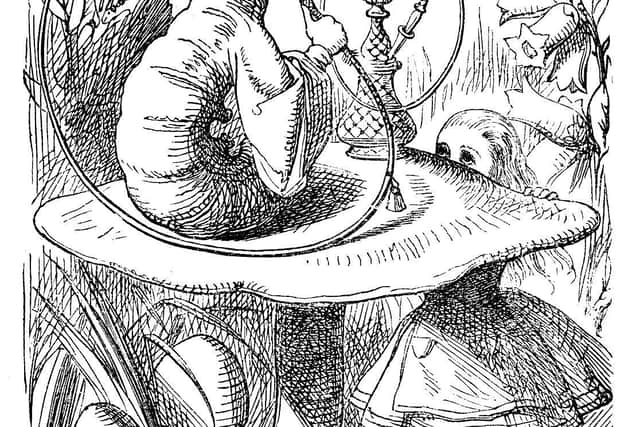
As a child I remember something about moving from illustrated children’s books to more grown-up books without pictures. To be honest this is probably when I fell out of love with text, or books that were pure text. As a youngster I was enthralled by Lewis Carol’s Alice in Wonderland and Alice Through the Looking Glass. I still have my grandfather’s copies. The stories themselves were immensely appealing, but I think it was the wonderful illustrations by John Tenniel that really caught my imagination. I loved the depiction of the White Rabbit with his waistcoat and pocket watch, and who could forget the caterpillar sitting on top of an enormous mushroom smoking from a Turkish hookah.
I’m sure it was the pictures, rather than the text, however brilliant it was, that allowed my imagination to run wild.