
Dr's Casebook by Dr Keith Souter: Some simple stretch exercises might help your Policeman's Heel


There are many things that can go wrong with your feet, and which can impede your enjoyment of sport, walking or running. The condition that we used to call Policeman’s Heel is one of them.
Before reaching for painkillers, anti-inflammatories and ointments – just incorporating a few simple stretching exercises might solve the problem.
The name seems to be a bit of an anachronism these days, going back to the time when police officers spent long hours pounding their beat. It is a painful condition of the heel and the arch, usually of one foot. It can affect anyone who spends a lot of time on their feet.
This is plantar fasciitis. The pain is worse when you first start walking after resting. Generally it gets better with a bit of moving about but then worsens when you stand, walk or run for a long time. People often find that it is painful when you stretch the bottom of the foot, as when you walk upstairs.
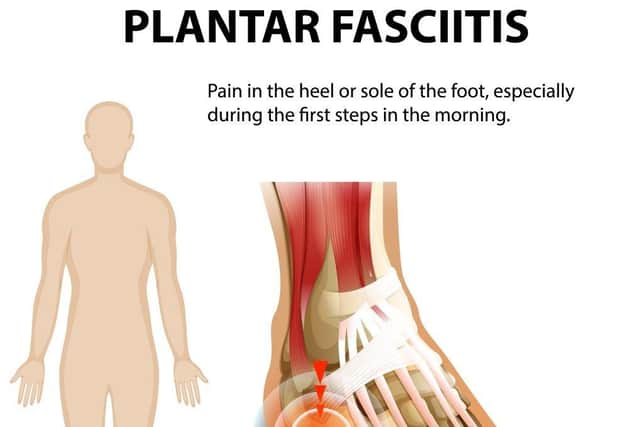
It is caused when the plantar fascia, the flat band of tissue that connects your heel bone to your toes is strained. It is more likely to occur if you have the wrong shoe shape, or when suddenly increasing sporting activity, especially in high impact activities.
These simple stretches are worth trying out. The first is a seated toe pull, which was first advocated after research over two years by the orthopaedic department at the University of Rochester. The stretch requires you to sit with one leg crossed over the other, and stretch the arch of the foot by taking one hand and pulling the toes back toward the shin for a count of ten. The exercise must be repeated ten times, and performed at least three times a day, including before taking the first step in the morning and before standing after a prolonged period of sitting.
A towel stretch is also simple to do. For this you sit with the legs straight out. Loop a towel around the ball of the foot. Now gently pull the towel towards you, keeping the knee straight until you feel a stretch in stretch in the arch and the calf. Hold it for a count of 30 seconds, then repeat three to five times.
The last stretch is a sort of push up against the wall. Face a wall and place your hands on it. Take a step back so that you keep the heels on the ground and the knees straight. Lean into the wall until you feel a stretch in the calf. Again, hold it for a count of thirty seconds, then push yourself straight, and then repeat three to five times.

If you give yourself two weeks of these you should see an improvement. But if your foot pain is getting worse or keeps coming back, or if you have tingling or loss of feeling in the foot, it is worth having it checked by a health professional.