
The Vintage Views column with Aled Jones: Entertainment on the north beach in 1932
Here’s view of North Side when theatres instead of a funfair dominated the area. Bridlington’s north beach is a hive of activity in this lovely seaside snapshot from the summer of 1932.
Holidaymakers stare at the camera quite unaware that an audience 93 years into the future are staring right back!
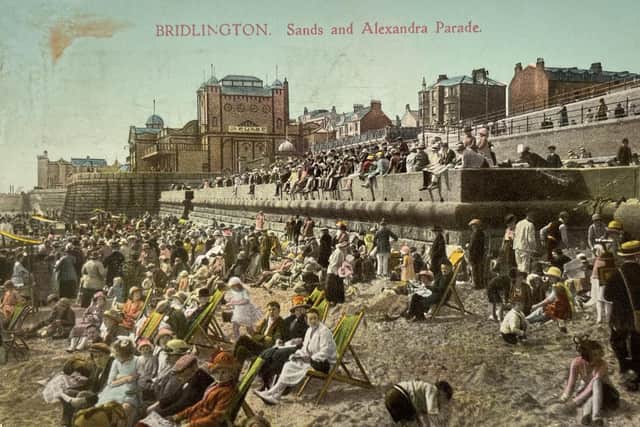

This great tinted postcard shows how popular our resort town has always been.
Hundreds of people are packed along the seafront and the golden sands below.
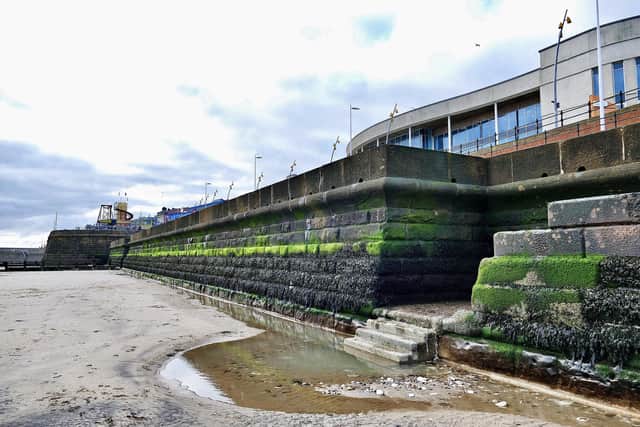
The prom here was called the Alexandra Parade, reflecting the importance of the Alexandra Hotel at this time.
The tented kiosks in the picture are no doubt doing good business – selling seafood (shrimps and lobster), ice-cream, chocolate, tea and cakes!
Wouldn’t it be nice to buy a cup of tea and a wedge of cake on the sands today (there’s a tea sign in the left background)?
Beyond the terraces, the Grand Pavilion Theatre is clearly visible at the end of Prince’s Parade.
In the background, the Victoria Rooms are also discernible in the photograph.
The Grand Pavilion was built in 1906 as the icing on the parade’s cake. It was opened in the same year by the Mayor of London and could hold almost 2,000 people.
This Oriental-style building was famous for its Banquet Hall as much as its spacious theatre. It was demolished in 1936 because it obscured the view across the bay!
Destroyed in a fire only a year after this image was taken, the Victoria Rooms had entertained thousands of visitors to our town.
A chief feature of the building was the castellated tower that gave it a weirdly Gothic-style appearance. Built in 1846, the Rooms contained a theatre, cinema, newsroom, billiard hall, carvery and tearoom. At the top of the tower was a shield with the three letters, B.B.B., forming the Bridlington coat of arms.
The 18th-century Fort Hall (top, right), a private residence, overlooked the seafront at the end of Fort Terrace.
The fine Georgian-era mansion, built around 1792, first occupied land on the edge of a fort, hence its distinctive name. It is rumoured to have been fired upon by a ship during the French Revolutionary war. The residence is notable for its association with the Graeme family of Sewerby, who bought it from its original builder, a John Walker of Fairburn, near Pontefract.
Fort Hall was demolished in 1937 at a cost of £15! In the 1930s no one spoke of buildings being ‘historically important’ but, if they had, they would have insisted that the hall be left alone.