
The Vintage Views column with Aled Jones – William Kent
The coastal town of Bridlington is well known, not only within the British Isles, but all over Europe and the world, as the birthplace of William Kent, the great 18th Century architect, painter and designer of interiors, furniture and gardens.
Of course, Kent is invariably considered our town’s most notable son.

William, whose surname was originally Cant, was born at number 45 High Street in 1685, the son of a prosperous carpenter and a man of some local standing, who served as one of the constables of the manor in 1691.
This 17th Century house, with its elegant six-bay façade, is one of the finest in the Old Town. It has a woodwork interior attributable to William’s father, also called William.
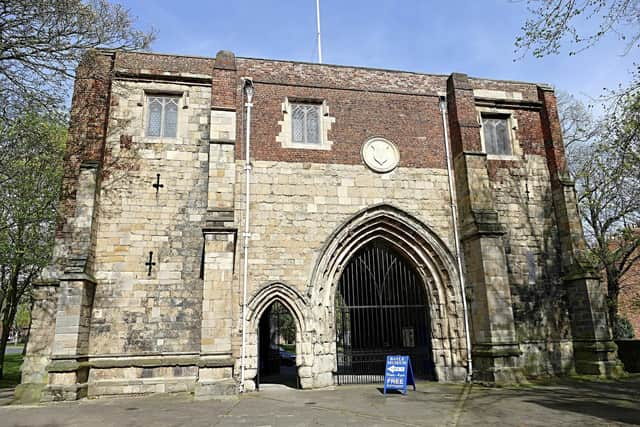
The young William attended the local grammar school, held in the medieval Bayle, the former gatehouse of the Augustinian Priory. It was only a short walk from his family home.
Little William Cant didn’t like his surname. So, when he was old enough, he refined the spelling to ‘Kent’ in order to avoid the mischievous innuendo he’d suffered at school.
After his education, William was said to have been apprenticed to a respected coach painter and house painter at Hull. While an apprentice, he became interested in Neo-classical art and design.
Local patrons, impressed by his talent and enthusiasm, sent him via London to study painting in Rome from 1709 to 1719. There he came under the tutorship of Giuseppe Chiari (1654-1727), a famous designer of churches and basilicas.
In Italy William soon encountered Richard Boyle, 3rd Earl of Burlington, and Thomas Coke, 1st Earl of Leicester, both of whom became important patrons for him.
Our hero image, a contemporary engraving, depicts William wearing an artist’s smock. He’d just been invited back to London to decorate Burlington House in Piccadilly, where he was then given permanent residence.
Appointed master carpenter in the Office of Works (1725), he went on to perform design work at Kensington Palace, the Royal Mews, the former Treasury building, Whitehall, and the Horse Guards Building, Whitehall.
His most famous gardening creations were at Stowe, Rousham, and Chiswick House. At Holkham Hall, Norfolk, he designed gardens and buildings for his patron Coke.
More locally, he worked at York Minster, designing a Gothic pulpit and choir furniture, sadly since removed.
Like his great tutor Chiari, many of William’s paintings are now priceless works of art, worth immense sums.
I personally think his greatest work is the Glorification of Indigo Jones, 1719-20 (Royal Academy of Arts). It was painted to honour the man who introduced the classical architecture of Rome into British architecture.
William Kent died in 1748, at the age of 63, and left his family back home in Bridlington well provided for.
Known to his friends and patrons as ‘Kentino’ or ‘the Signor’, he was a kind and warm hearted man who’ll be forever remembered as the father of the English landscape garden.
“All gardening is a landscape painting” – William Kent.