
Vintage Views: the final days of light cruiser HMS Falmouth
The treacherous seas off Flamborough Head have been witness to a phenomenal number of shipwrecks.
Over the centuries numerous vessels, built for both trade and war, have met their end off our coast taking many lives.
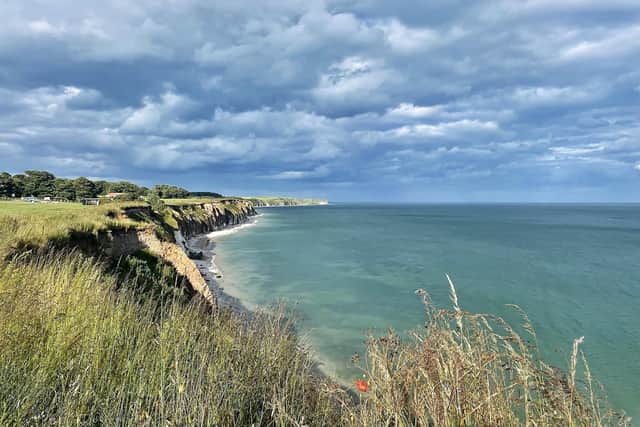

It has been estimated, that since the year 1500, over 50,000 vessels have come to grief on the Yorkshire coastline.
Potent weather fronts and lethal currents were often the undoing of even the most able mariners.
The worst maritime disaster at Bridlington was the Great Gale, on February 10 1871. Freak storm conditions on the day led to the loss of some thirty ships and more than 70 seamen.
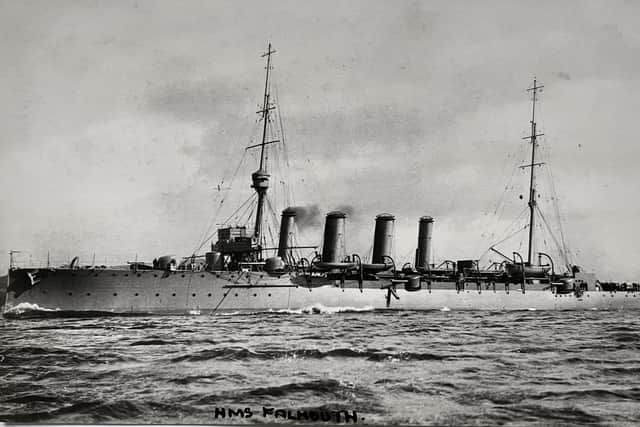
In rare cases military action, not bad weather, has been the cause of a wreck here. The ship featured in today’s vintage postcard, the light cruiser HMS Falmouth, met her end at the hands of a German U-boat in Summer 1916.
Built by William Beardmore & Company at their Dalmuir shipyard in 1910 and launched on September 20 of the same year, HMS Falmouth was the ninth ship in the Royal Navy to be named after the eponymic port.
She was commissioned in September 1911 and assigned to the 2nd Battle Squadron of the Atlantic Fleet. After a successful trial period, Falmouth was transferred to the 5th Cruiser Squadron of the Grand Fleet. On the outbreak of war in August 1914, she fought in most of the early fleet actions and sank four German merchantmen.
She was formidable, thanks to a top speed of 25 knots and a uniform armament of eight 6in (152mm) guns, four 3-pounder (47mm) guns and two submerged torpedo tubes.
During the Battle of Jutland on May 31 to June 1, 1916 the heroic Falmouth fired a total of 175 shells, by far the most of any British light cruiser.
Calamity befell her on August 18 when she was hit by a torpedo from U-66 while screening Beatty’s Grand Fleet. She was towed to the vicinity of Flamborough Head, where she was torpedoed again, this time by U-63, sinking the following day.
Miraculously, however, only one crew member was killed in the two attacks!
Heavily salvaged after the war, Falmouth’s wreckage sits in 16 to 21 metres of water, about eight miles south-east of Flamborough near Skipsea. She is regarded as one of the best diving sites in Europe.
Flamborough Head is also famous for a much earlier naval confrontation, on September 23, 1779. It was fought between the USS Bonhomme Richard, a 34-gun American frigate under the command of John Paul Jones, and the vastly superior HMS Serapis of the Royal Navy.
The two vessels brutally battled for more than three hours, resulting in over 100 deaths and the sinking of Commodore Jones’s ship. It was a Pyrrhic victory for the British. Ironically, their ship was boarded and captured just as the American man-of-war began to capsize!
The wreck-site of the USS Bonhomme Richard continued to baffle until 2001, when it was confirmed that a location off Flamborough Head was certain to be the world-famous ship.