
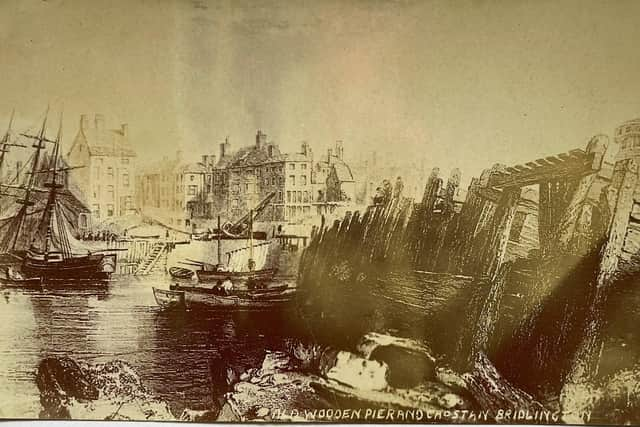
Vintage Views with Aled Jones: An evocative image of Bridlington harbour in 1817
Bridlington harbour as it appeared in 1817, showing the old North Pier (right) and sailing ships and also the crane at Crane Wharf (middle, distance). The wooden crane was sited at the head of the jetty during the days of coble fishing, when fish landings were carried up there to be spread out and sold.
In this era the harbour was only a third of today’s size. Both piers were built of wood infilled with rubble, which necessitated constant repair of the harbour structure. The cost of this was passed on to merchant ships that used the port.

The old North Pier was popular with people who paraded in all their finery. Charlotte Brontë, on her visit to the town in September 1839, joined them one day but found the whole experience quite absurd. The harbour attractions of watching the sailing ships and conversing with the fisher folk were far more to her taste!
It is believed that Charlotte based the fictional seaside town of “Bretton” in her 1853 novel Villette on her holidays to Bridlington.
Charlotte loved the sound of the waves, the smell of the sea breeze. For her a stroll along the pier, with the waves rolling beneath her feet, and the wind blowing in her face, must have felt like she was on a huge ship!
In the mid-18th Century visitors were first attracted to Bridlington to bathe and take in the sea air. Both pursuits have never failed to enliven, since in 1923 Bolton Wanderers won the FA Cup after spending a week here!
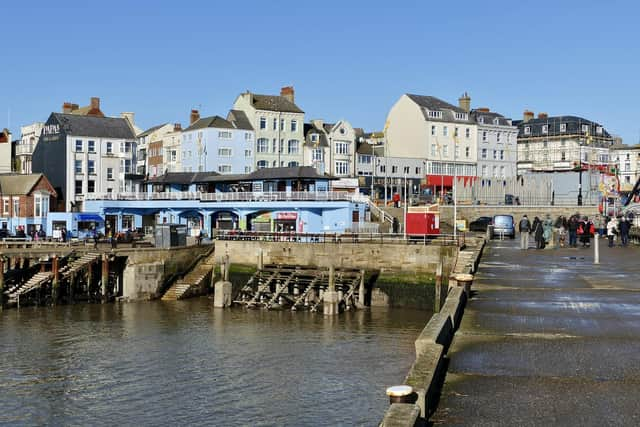
This Edwardian postcard (reproduced from an original painting) shows how much and yet how little the Quay has changed since those times. The substantial house in the left background was built c.1730 and still stands today. Originally the old coastguard station, it is now Papa’s Fish & Chips.
By the 19th century the piers had become dilapidated due to being infected with ‘ship worm’ (Teredo Nevalis) brought by shipping from the tropics. Within 50 years they had been completely superseded by stonework.
With the completion of the stone piers in 1848, the area of water in the harbour expanded to cover approximately 12 acres, and the increased size allowed for as many as 300 vessels to be moored.
When the South Pier was under construction, 200 workmen were ordered to be put in the pillory for working on a Sunday. However, only a few of them received the punishment as there weren’t enough pillories to go around!