
Vintage Views with Aled Jones - Flamborough’s rural past
Postcards open a magical gateway to the past and today’s example is no exception.
This beautiful image, taken circa 1910, captures the essence of Flamborough’s rural past, set against the backdrop of St Oswald’s Church, so-named after the patron Saint of fishermen.
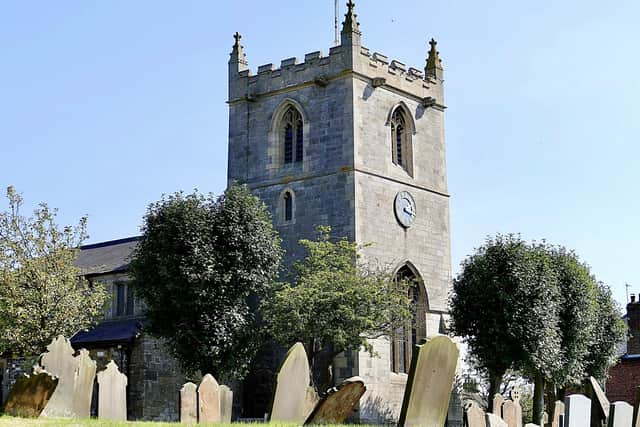

It offers a fascinating glimpse into a bygone era, where the Wolds wagons played a significant role in the village’s economy and daily life.
A wagoner (coal man) is sitting on a horse to the left; they would invariably ride the nearside horse, especially when three horses were hitched to the wagon.
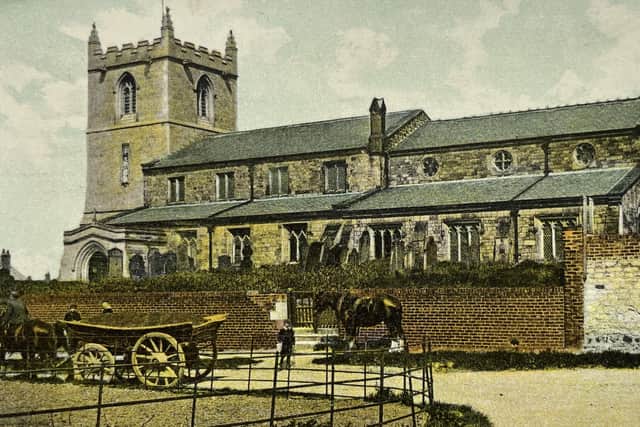
There are two horses hitched to the wagon already, the third is taking a well-earned rest on the path in front of the church. They are all muscular Shires.
Notice the magnificent wall to the right, constructed from chalk boulders found on the nearby beach of North Landing.
Flamborough church is believed by some historians to predate the Norman invasion, as it’s first mentioned in a charter of 1094-1100, which records that it was given by Hugh, earl of Chester to Whitby Abbey.
The official line, however, is that the church of St Oswald dates only to the Norman era and was granted to Bridlington Priory by William FitzNigel, the lord of the manor.
It’s essentially a 12th century church that was extensively rebuilt and restored in Victorian times. When the building work commenced, in 1868, the church had ‘no tower, only a wooden belfry.’
It was later in 1897 that the present tower came into being incorporating a fish weathervane in honour of St Oswald.
The parish church of St Oswald stands on a small rise at the west end of Church Street. It dates to 1150 and still has the chancel arch and font remaining from the original Norman church.
A splendid south aisle was added around 1200, and a north aisle some 50 years later.
St Oswald’s was designated in 1966 by English Heritage as an important Grade II* listed historic building.
Rightly so, it contains a carved choir screen said to have been taken from Bridlington Priory at the Dissolution, to protect it from the kings-men who destroyed the greater part of that magnificent religious house.
The choir screen belongs to the 15th Century and is a delightful example of medieval ecclesiastical art. It’s surmounted by an impressive rood loft containing fourteen canopied niches for statues long removed.
In the village are the sparse remains of Flamborough Castle, also known as the Danish Tower, a medieval fortified Manor House built in the 14th century by the powerful Constable family. The ruins are a scheduled monument.