
Vintage Views with Aled Jones: The signal tower on Bessingby Hill
Ascending to the top of Bessingby Hill on the Woldgate Roman road affords one of the best prospects of Bridlington in the area, and during the French Revolutionary war, an order was given, authorising the construction of a signal tower, to be built on the downslope of the hill.
This early warning station was to notify the local Militia (formed 1809) of an impending French invasion. The tower was only a small whitewashed building but it commanded superior views of Bridlington Bay. It might not have cost much to build but its value was priceless.
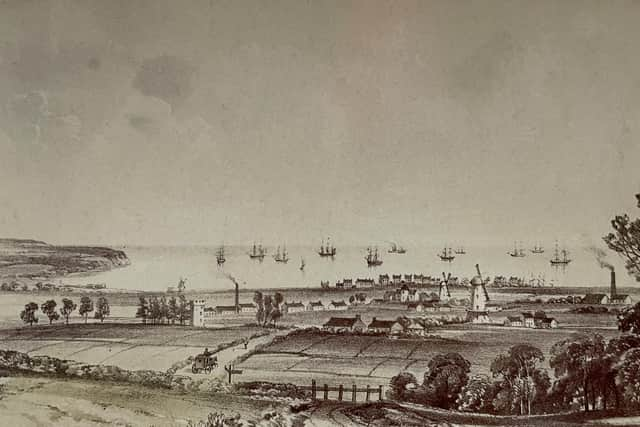

Built in c.1810 the tower (left, middle) features clearly in this nostalgic Edwardian postcard. Bringing the past to life, it’s a reproduction of an 1854 lithograph showing the Quay from Bessingby Hill.
A major feature of the tower was that it was castellated and had loopholes for musket fire. It used bonfires at night and flag semaphore during the day to transmit warning messages to the Quay.

The garrison defending Bridlington Quay was based in a fort overlooking the sea at the end of Fort Terrace. This battery was armed with seven twelve-pounder canons, all of which had a range of four miles. A Captain Harland was the Commanding Officer.
Interestingly, the historic Bayle in Old Town was also used as a garrison for Napoleonic soldiers.
The future site of Bridlington Grammar School (b.1899) lies just in front of the tower on the left of the image. Burlington Old Town is located in the middle distance.
When the tower was built, Old Town had a significantly larger population than the emerging Quay area – 3,130 compared with a mere 687 at the Quay!
There are plenty of schooners evident in the Bay as well as the larger brigs. The paddle steamer in the middle distance must be the United Kingdom, Bridlington’s first pleasure boat. Chalk cliffs, mills and industrial smokestacks complete this early Victorian scene.
Bessingby’s Napoleonic-era signal tower evolved into a farm storage facility before being assigned to Bridlington Grammar School.
The tower was fitted up by the School as a meteorological station in 1923 and remained as such for twenty years. At the start of WW2 it was recognised by the Air Ministry but ceased to function after the summer term of 1943.
The tower lasted until the 1960s when Bridlington School started to expand, erasing the edifice permanently. A sports college covers the site of the tower now.