
Vintage Views with Aled Jones: the thrill of a Pierrot Show
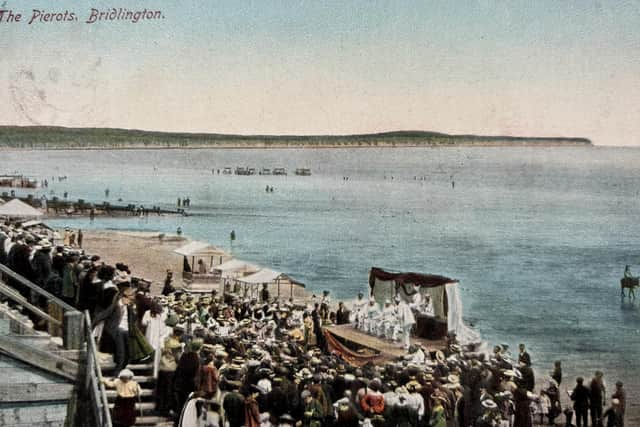
Nobody today will remember make-shift stages, like this one, offering beachgoers the thrill of a Pierrot Show.
A seat for 1d (or ½d for those standing) in 1908 looks cheap today.

This view shows the Waterloo Pierrots performing in front of a large audience. Despite it being almost high tide the show must go on!
In addition to their pitch on the beach the Waterloo’s had an open-air theatre on the Beaconsfield Estate near Trinity Church. The venue was known as “Summer Gardens” and was a popular spot for courting couples. The site is now occupied by Premier Inn.
It became something of a tradition for many visitors during the early 1900s to take in a show at these lovely gardens.
The photographer was here standing on the old sea wall (built 1859), now occupied by the terraces of the Victoria Wall. A wooden board-walk, and a crowded one at that, can be seen on the left.
Back then, beach life was more entertaining and this is reflected in the provision of phonographic machines, Punch & Judy shows, musicians, phrenologists and palmists. There were also pony and donkey rides, coconut shies, a cable ride and even a carousel – all contrasting with the present day usage of the beaches.
This colourised image shows an ice cream stand and a drinks kiosk, which can be spotted to the left of the stage. There is a row of bottles to be seen on close inspection of the photo.
Several wheeled bathing vans can be seen in the distance on the foreshore. These were a must when undressing on the beach was forbidden. At this time owners paid five shillings per van for using the beach for the season.
To the right foreground is a solitary donkey rider, in the days of free-roaming. In old East Yorkshire dialect a donkey was known as a “fuzzock!”
In the distance may be seen the beautiful chalk cliffs of Flamborough. Note the mound of Beacon Hill just to the left of the headland.
The message on the back of the postcard, dated 9 August 1908, ecstatically reads: “Splendid, magnificent, glorious, superb, extra special, charming, exquisite weather we are having. All been to Chapel this morning and all helped to swell collection.”