
Vintage Views with Aled Jones: Focusing on the Bayle Gate
Bayle Gate in the 1930s, at a time when a public park was sited right in front of the Bayle – it went long ago to widen the present road.
Known as Priory Gardens, it was popular with residents and visitors alike.
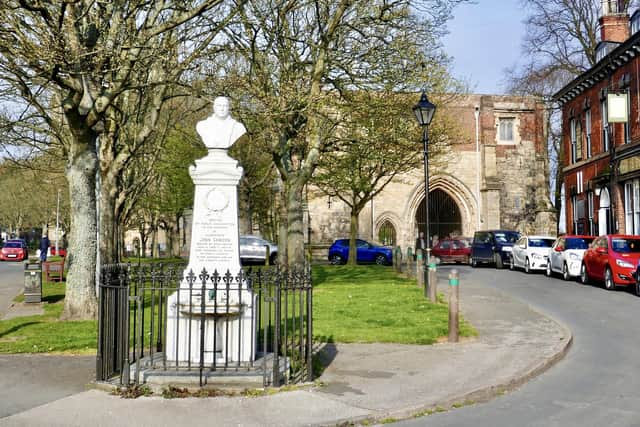

Before the park was built, quaint 18th-century houses went right up to the Bayle and much of the character of the area was lost when they were cleared away.
Their removal was part of the council’s ‘gentrification’ policy.
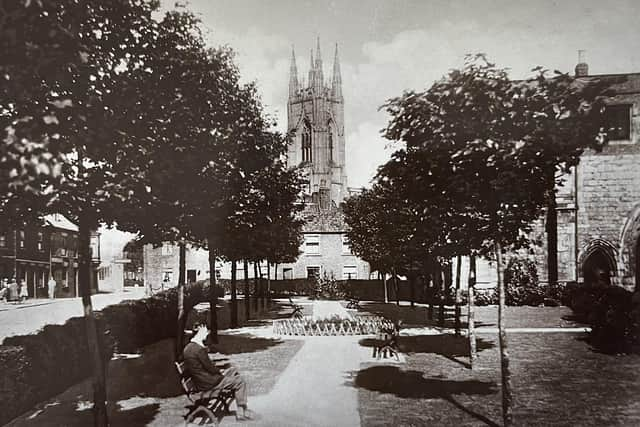
The gardens were a beautiful treelined seating area with nice kept flower beds and pathways. Luckily, many of the trees shown in the image still stand today.
They have seen extraordinary growth in the past 95 years!
The area to the left, on the south side of Kirkgate, was the site of homes that were demolished to create the road.
The dwellings that survive on the north side of Kirkgate today are all that is left of a once proud and close-knit community.
The West side of the Bayle is shown to the right of the image. Built in the later Middle Ages, it was the main entrance to the Priory Monastery and after the Dissolution saw many uses – prison, court house, school, town hall, etc.
It was built to impress pilgrims as they rode up to the Priory grounds – defensively, it acted as a standalone protective strongpoint, removing the need for an adjoining wall around the monastery.
Evidence of its strategic nature is provided by its powerful buttresses and surviving arrow loops.
Two kings of England passed through the Bayle on their way to worship at the shrine of St John; firstly Henry IV in 1407 then Henry V, in 1421, accompanied by his French queen Catherine of Valois. Imagine the bustle and excitement on those days!
Our picture postcard was taken at a time when the road still passed through the medieval gateway. It dates to 16 September, 1930, and was mailed to an address in Fishponds, Bristol.
Just three years later a huge renovation programme of the Bayle began at great cost to the Lords Feoffees that owned the building. It involved a thorough re-building of the roof, floors and upper interior.
The dramatic tower of the Priory Church of St. Mary the Virgin looms in the middle distance. A Gothic revival, it was added in 1870 by Sir George Gilbert Scott who also restored the medieval Nave.
The cottages sited directly in front of the church were demolished after WW2 to create a through road.
On a lighter note, notice the two boys (left) running outdoors. One boy brandishes a toy sword, while engaging the other in a comical street chase.