
'224 steps avoided for 1p' - Scarborough Spa Cliff Tramway celebrates 150th anniversary
One of Scarborough’s numerous historical distinctions, the Spa funicular, the first such cliff tramway to operate in Great Britain, has marked its 150th anniversary with an exhibition at Scarborough Spa.
Patrick Argent recounts the development and background to this most idiosyncratic of public railway systems which is an inextricable part of the town’s Victorian heritage.
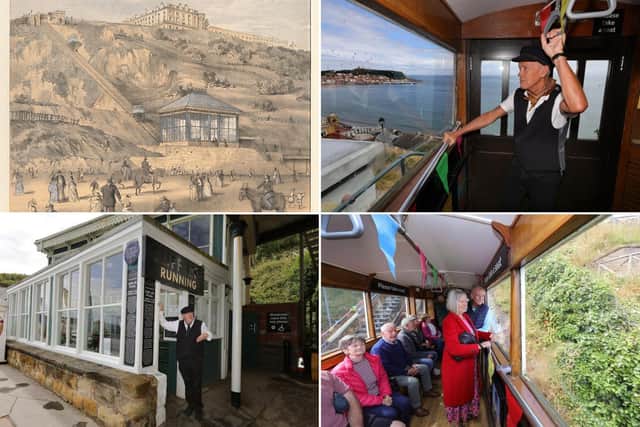

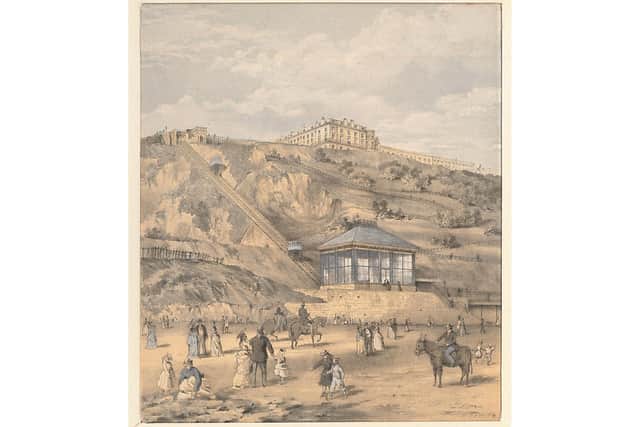
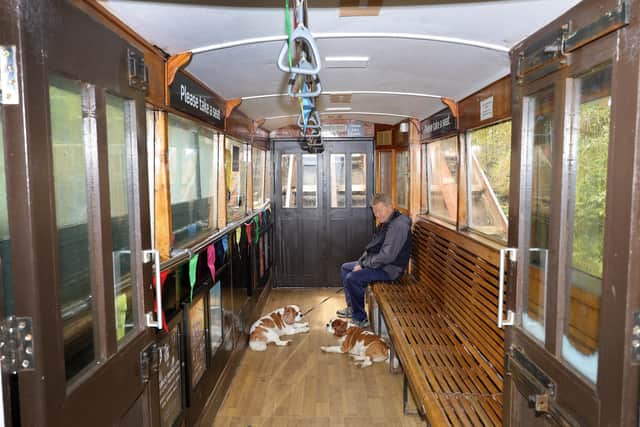
Synchronously ascending and descending at an equal speed, the two carriages of the cliff lift adjacent to The Spa have been a familiarly engaging sight to both residents of and visitors to the South Cliff since 1875.
Funiculars (or cableways), involve a cable attached to both cars on rails moving vertically up and down a steep gradient, the carriages counterbalancing each other.
Driven by two gas engines, the original Spa hydraulic operating system pumped sea water through a central pipe filling the water tank supplying the upper carriage.
Having had the weight of this car greatly increased, as the brakes were released, gravity resulted in the upper car descending, whilst simultaneously the lower car with the empty tank ascended.
Reaching the bottom, the water tank was emptied, where the process would then begin once more with the car now at the top.
Long acknowledged as a geographical hinderance to the burgeoning development of tourism, Scarborough’s inherent topography would see the first of five such cliff-based transit systems established across the town;
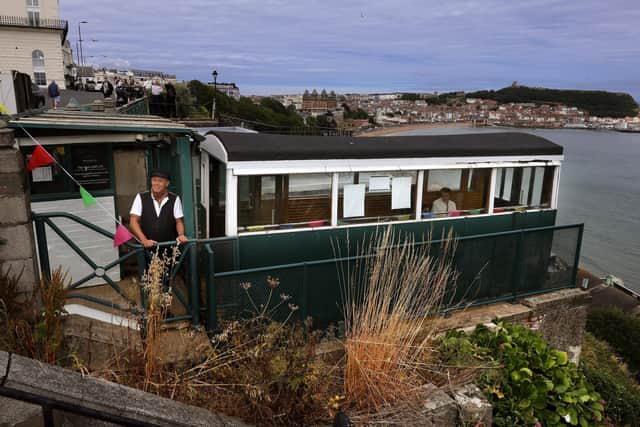
the Spa facility first opening for passenger use on July 6 of that year.
Formed in 1873, The Scarborough South Cliff Tramway Company Limited had sought to specifically alleviate the inconvenience of accessing the Scarborough Spa by foot, then the most popular music venue outside of
the capital. This situation was concisely illustrated in a period photograph featuring an exterior sign that advertised: ‘Spa Cliff Tramway - 224 steps avoided for 1p’.
This key objective would become the catalyst for its construction, providing an immediately accessible direct link between the cliff-top Esplanade and the pre-existing entertainment complex.
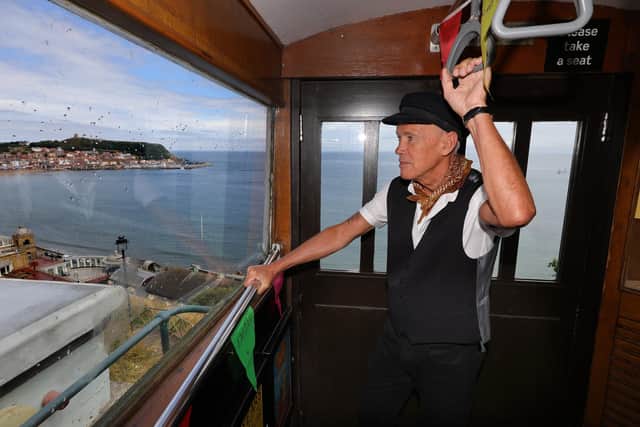
The 224 steps, effectively a drop of approximately 275 feet over a gradient of 1 in 1.75 would soon be travelled in 47 seconds in a new and unique form of public transport in the UK.
Designed by William Lucas, a London-based consulting engineer and manufactured by Crossley Brothers of Manchester, The Metropolitan Railway Company of Birmingham supplied the two carriages, each capable of carrying 14 passengers.
Immediately popular and viewed at the time as the embodiment of modern technology and convenience, it succeeded in drawing 1,400 customers on the first day of opening alone.
“Interestingly, funicular railways are all unique with their own individual nuances”, explained Christopher James, operations manager at Scarborough Spa, “The lift is still operating successfully as it did 150 years
ago with roughly 100,000 journeys taken annually. It is oddly timeless”.
The emergence of a series of cliff lifts reflected the rapid development of Scarborough’s status as a leading resort and the provision for its expanding holidaymaker clientele via the expansion of the mainline railway network.
The Spa tramway attracting nationwide interest, served as an exemplar for other British seaside towns in the ensuing years, who followed Scarborough’s lead in also installing cliff railways in response to their similarly increasing popularity as holiday destinations.
The town would develop a wealth of funicular railways with four other such tramways built over the subsequent decades.
The Queens Parade Cliff Lift (1878), The Central Cliff Lift adjacent to The Grand Hotel, completed in 1881 (still operated privately by The Central Tramway Company to this day), St. Nicholas Cliff Lift (1929) and the North
Bay Cliff Lift (1930).
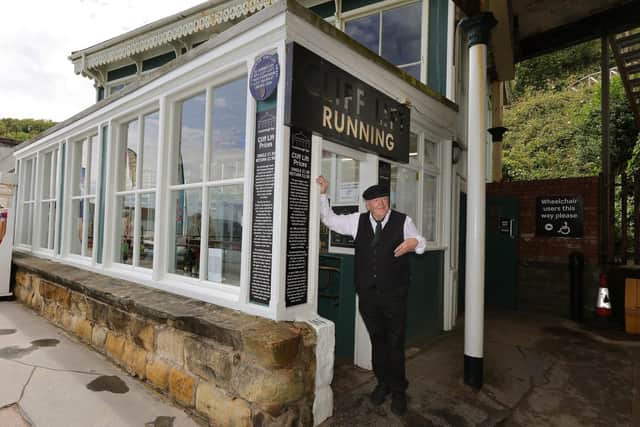
By 1888, the Spa tramway was carrying 250,000 passengers annually with the height of its popularity emerging during the immediate post-war 1945-46 season, where passenger numbers would reach a peak of 1.2 million.
Refurbished numerous times in its history, the original gas engines were replaced by steam pumps in 1879 and additionally in 1947, the hydraulic system was replaced by electricity, then extensively modified to be operated automatically in 1997.
The Victorian carriages were replaced by two built by Hudswell Clarke & Company in 1934–1935.
In 1993, the lift was purchased and operated by Scarborough Borough Council, consequently acceding to the ownership of North Yorkshire Council as a unitary authority in 2023.
Closed for essential safety repairs in 1998, the lift had a complete overhaul in more recent times both during and just after the Covid-19 period.
A prevailing part of the town’s public transport infrastructure, this pioneering facility functions in continuing to provide the exact same service as it did in 1875.
“Today we are obviously Council-owned and have a bit of a balancing act for when we are open”, Mr. James continued, “in firstly producing an income but also as we are a convenience for the public, opening for the
shows at The Spa”.
Aside from Sir George Cayley’s manned glider launched in 1853 over two decades earlier (essentially the very beginnings of modern flight), the Spa cliff tramway (or Incline Carriage-Way) can arguably also be acclaimed as
another 19th century transport first originating in the Scarborough area.
Fittingly so, in consideration with the forthcoming 400th anniversary of the town in 2026 commemorating the establishment of Scarborough as Britain’s first seaside resort.
Tangibly evocative of a past era, today the town’s two remaining funiculars are part-living transport museum, part-heritage railway, part-stand-alone tourist attraction in addition to being an invaluable and enduringly functional legacy of Victorian Scarborough.