
'Extremely rare' Iron Age coin sells for £3,300 at Scarborough auction
It’s been revealed that a gold coin that lay buried in an East Yorkshire field for 2,000 years before it was unearthed by a metal detectorist is to shine in what is planned to be a major private collection of British coinage.
The coin - an extremely rare variant of a Corieltavi gold stater, minted by the Iron Age Celtic tribe that occupied most of the East Midlands including the whole of Lincolnshire in the first century BC - sold for £3,300 when it went under the hammer in Scarborough, almost twice the amount that had been paid the only other coin of its type ever found.
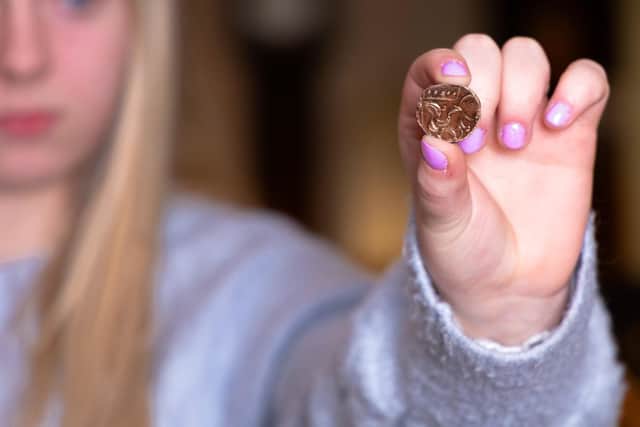

Coralie Thomson of auctioneers David Duggleby said: “The stater was a domino type, so called because of pellets that appear in a rectangular frame on the face of the coin.
"Corieltavi domino staters all had four pellets - or so everyone thought until a five-spot stater was found in Northamptonshire last year.
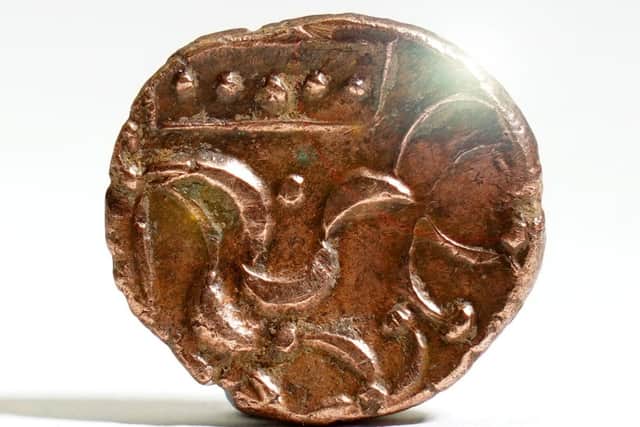
“Quite why the Coritavian minters – who were based at Sleaford in South Lincolnshire – added an extra pellet to some coins is still a matter of speculation but from a collecting point of view it’s a gamer changer, hugely increasing the value.
“I could scarcely believe my eyes when the detectorist turned up at our York saleroom with the five-spot stater that he had unearthed near the small village of Lelley about seven miles from Hull.
“The Northamptonshire coin made £1,750 when it was sold in an auction in Mayfair in November but our view was that even though the Lelley gold stater was the second to come up for auction it would do even better.
"It went into last week’s timed online Coins, Banknotes and Stamps Auction with a pre-sale estimate of £2,000 to £4,000.”
With the sale attracting international collector and media interest, bidding soared past £2,000 days ahead of the auction.
At the death it finally came down to a contest between two bidders, one in Northern Ireland and the other based in London, a private collector who won the day with a £200 increase in his bid - to £3,300 - in the last ten seconds of the auction.
The collector has opted to remain anonymous but he has revealed that he is in the early stages of creating what is intended to be a major collection of British coinage.
The Lelley five-pellet domino stater is the oldest coin that he’s acquired to date.
He said: “I really am delighted to own this wonderful East Yorkshire find which I’m sure will always be star attraction in the collection."
Elsewhere the highlights of the auction included a 1989 Queen Elizabeth II gold proof Britannia four-coin set (one hundred to ten pound) that made £4,700, a 2019 Queen Elizabeth II Alderney Queen Victoria 200th anniversary three-coin sovereign set (full to quarter) went for £1,100 and a 2019 Queen Elizabeth II New Zealand three-coin sovereign set made £1,000.