
Scarborough duo relate cinematic backpacking adventures of ‘A Bridge Too Far’
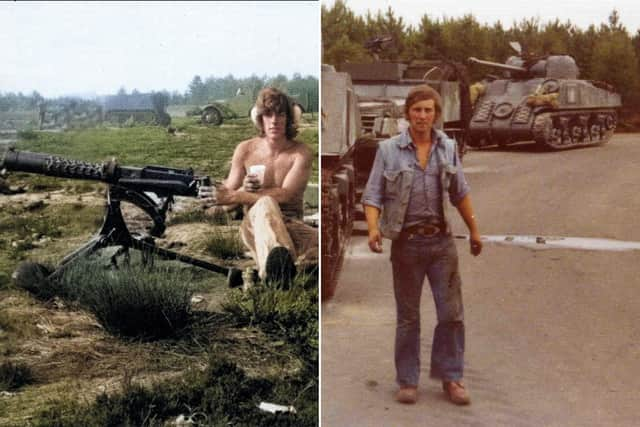
Fifty years ago, whilst hitchhiking across the Netherlands, two Scarborough teenagers, Paul Wilson and Alan Clark, found themselves inadvertently working in the special FX department on the set of a classic war film. Patrick Argent relates the unusual story of how the duo were involved in the production of the WW2 epic.
Filmed during the spring/summer of 1976, ‘A Bridge Too Far’ depicts the ill-fated Allied Operation Market Garden assault on Nazi-occupied Holland in September of 1944, the largest airborne deployment ever comprising 34,600 paratroopers over several days across three areas.

Directed by Richard Attenborough, the ensemble cast comprised a seemingly unmatched stellar list of eminent British and American film actors. These included no less than: Laurence Olivier, Robert Redford, Sean Connery, Edward Fox, Dirk Bogarde, Michael Caine, Anthony Hopkins, Ryan O'Neal, Elliott Gould, James Caan, Gene Hackman, Liv Ullman, in addition to Hardy Krüger and Maximillian Schnell.
Seeking adventure abroad on a limited budget, the two friends initially decided on a backpacking tour through France in search of temporary farm work to subsidise their trip.
Unbeknown to them on leaving Scarborough, they would enter an ostensibly unreal realm of experience they could never even have begun to imagine.
Fortuitously, circumstance, pure chance and a positive entrepreneurial approach, would lead them to securing an extraordinarily rare work opportunity.
Embarking to the Continent from the ferry terminal in Hull en route to Rotterdam and intending to procure a lift to France, they had befriended the truck drivers on the voyage across the North Sea. Acquiring transport with a driver to Mons in Belgium, they then impulsively reconsidered their options, deciding to head back to explore Holland accompanying the driver on his return journey.
This abrupt change of plan derived from nothing more than a momentary whim, would subsequently emerge as a masterstroke decision.
Entering Twello, near to Deventer, the truck driver’s destination, the first indicator of their future roles came as they were astounded to see a WW2 German Panzer tank in the road. Departing from their driver, they found a bar which most unusually, was packed with English people and discovered a major war film was being shot locally.
Enquiring about any potential work, they were directed to the production office across the road.
Asked to return later, they were assigned jobs as overnight security guards for a house intended to be the set location for the next day. Having left England less than 48 hours earlier, they were now to be working amongst some of the elite of the film industry.
Opening the door the next morning, an astonished Mr. Wilson would find the first surprise of many in Richard Attenborough working directly outside with one of the crews.
To their amazement, for this initial task they were paid almost as much as they had originally set out with.
Alan Clark recalled: “My first day was unforgettable—and terrifying. It involved a scene in a basement where Anthony Hopkins, playing Colonel Frost, lay wounded. I was instructed to climb onto a beam above him and shake a heavy sandbag to simulate dust falling during explosions. As I clung on, Richard Attenborough calmly called out, “Boom… and boom...”.
All I could think was: if I drop this bag on Anthony Hopkins’ head and kill him, this will be the shortest job I’ve ever had”.
Finding accommodation with a hospitable Dutch family, they were joined by a then 17-year-old Joss Williams who would later develop a career in visual effects winning an Oscar for his work on the fantasy picture ‘Hugo’ (of 2011).
“From then on, Alan and I began collecting our own stories. Alan carried a Kodak Instamatic camera and took many photographs. Though the quality wasn’t great, they became priceless memories”, Mr. Wilson remembered.
Setting up multiple explosions, creating large scale smoke effects to simulate distant battles for live-action shooting, giving Sean Connery his orange juice, guarding Anthony Hopkins’ caravan, accompanying Hardy Kruger and Maximilian Schnell across the set in German uniform were amongst many memorable and often surreal moments Mr. Wilson experienced.
Given the gravity of the film’s subject, there was a particularly poignant instance as he recalled: “During filming in Zutphen, an elderly man broke down in tears while watching a scene involving German officers and swastika flags. It turned out he had lived through the war, and the scene brought back painful memories of losing his wife”.
They continued to work daily on numerous and varied aspects of the film’s production across the summer until late September.
Paul Wilson became a professional press photographer and latterly was the proprietor of The Victorian Image photo studio in Sandgate, Whitby.
Alan Clark subsequently worked as a HGV driver before becoming involved in the sport of truck racing for many years, now residing in Worksop in Nottinghamshire.
Premiered in 1977 and running at a lengthy 176 minutes, the picture became the most expensive war film ever made.
Costing $25 million and returning some $50.7 million at the box office, it would result in being the sixth most popular film of that year in the US in addition to receiving several Oscar nominations.
Eminent cultural historian and film writer Sir Christopher Frayling said: “‘A Bridge Too Far’ was a big hit with audiences (all those stars and spectacular set-pieces) but did not go down well with the critics. Especially in America, they didn't like the story of an Allied failure in the Second World War. In retrospect, that is one of the film's strengths. Like ‘Lawrence of Arabia’, it manages to be epic in scale - but with a seriously downbeat last reel. Hollywood would much have preferred 'Operation Market Garden' to have had a happy ending...”.
A 50th anniversary exhibition of the filming was staged earlier this year at Museum De Waag in Deventer.
Remarkably the film includes the on-screen FX work of two enterprising Scarborough teenagers, who unexpectedly were in exactly the right place, at exactly the right time to be within the apex of mid-1970’s international film.