
Stunning 2,000-year-old Iron Age coin to go under hammer at Scarborough auction
A 2,000-year-old gold coin unearthed by a metal detectorist in an East Yorkshire field has been predicted to make thousands when it goes under the hammer in an auction in Scarborough on Thursday January 8.
The coin is an almost unheard-of variant of a Corieltavi tribe gold stater, minted in Lincolnshire in around 50-10BC.
Coin experts say it is thought to be only the second ever found.
The Corieltavi was an Iron Age Celtic tribe that occupied most of the East Midlands including all of Lincolnshire right up to the south bank of the Humber although intriguingly the spot where the coin was found, the Holderness village of Lelley, half a dozen miles north of the river was the territory Parisi tribe which occupied a swathe of East Yorkshire.
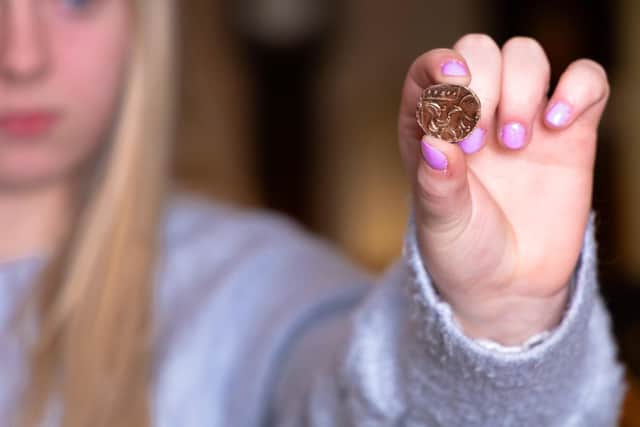

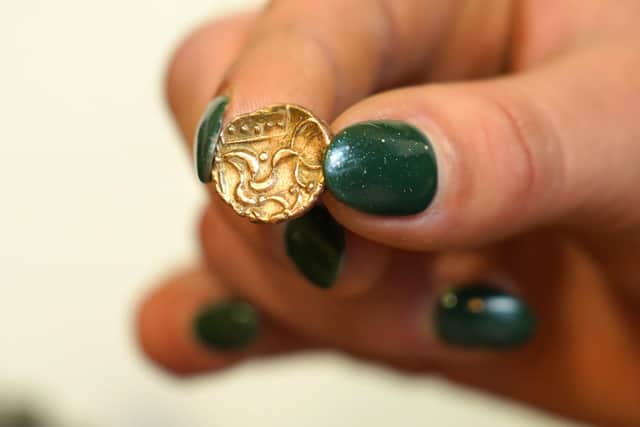
The coin is small, about the size of the old decimal halfpenny, weighs 5.5 grams and has a composition that is 33% gold, 54% copper and 9.5% silver.
Coralie Thomson, a specialist with auctioneers David Duggleby, said: “The stater is of the ‘domino’ type, so called because of the pellets that appear in a rectangular frame above an abstract depiction of a horse on the coin.”
“It is the fifth pellet on this coin that make it so incredibly rare. Corieltavi staters always had four pellets - or so everyone thought until a five-domino variant was unearthed in Northamptonshire last year.
"This East Yorkshire coin would appear to be only the second ever found.”
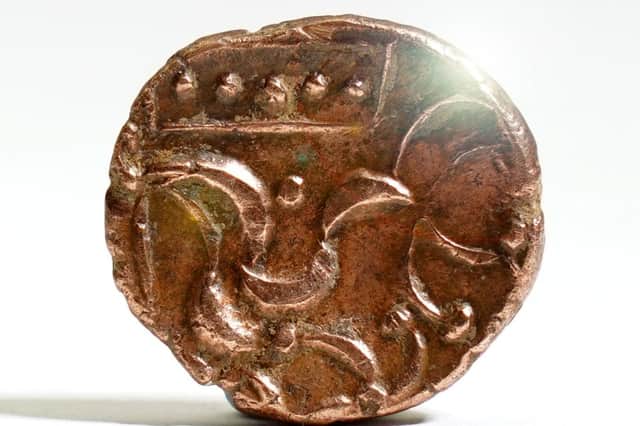
“One extra pellet might seem insignificant but in terms of collectable desirability it is an absolute game changer.
"We’re talking a doubling or trebling of auction value.”
Coralie said the reason the Corieltavian mint - which was sited at Sleaford - added an extra pip to the domino on a very small number of coins is a mystery.
She said the answer could be as simple as the fact that a die used to create the coins was recut after becoming worn and at that stage acquired an extra pellet.
There has also been speculation that it may be a variation in mintmarks or issue date or gold content or something else that isn’t known at the moment.
Coralie said: “It’s tempting to think raiding, robbery and murder but the two tribes were apparently pretty civilised - at least by Iron Age standards - so it is more than likely evidence of trading between the two peoples.
"Corieltavi coins do turn up regularly in Yorkshire.”
The stater goes into David Duggleby’s auction of Coins, Banknotes & Stamps on Thursday January 8 with a pre-sale estimate of £2,000 to £4,000.
The sale also includes a glittering array of gold coins ranging from a Henry VIII gold angel, through a run of George III spade guineas to over a dozen full sovereigns from the reigns of Queen Victoria, Edward VII, George V and Elizabeth II.
A Queen Elizabeth II 1989 gold proof Britannia four coin set, one hundred pound to ten pound, cased with certificate is expected to make £3,000 to £5,000.
There are also gold Napoleons (France), Marks (Germany), Ducats (Hungary), Guilders (Holland) Dollars (USA) and Zecchinos (Venice).
Visit www.davidduggleby.com to seethe full catologue.
The sale is a fully automated online auction that starts at 11am.