
The Lost Victorian Hindu-Moorish Underworld
Mention ‘Aquarium Top’ to any Scarborian and there is an immediate recognition of a specific area adjacent to the Spa Bridge which was named after a pioneering aquatic amenity that in its original form was established in 1877.
Patrick Argent recounts the turbulent story of one of Scarborough’s most vaunted and eccentric of unredeemed Victorian attractions.
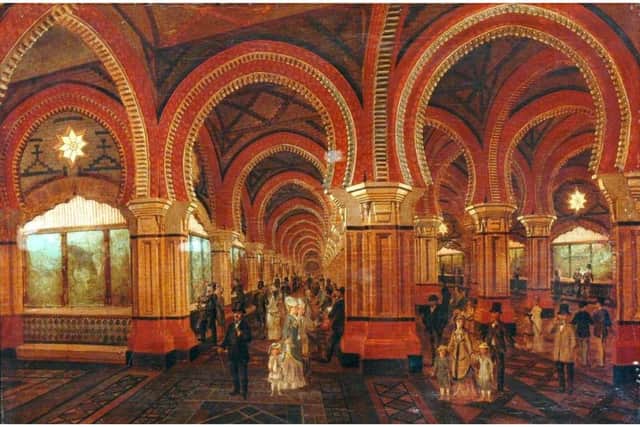

Outwardly appearing as a wholly unremarkable area today, belies the extraordinarily exotic venue that once occupied the underground space between the beach and the junction of Valley Road, Ramshill Road and Vernon Road.
To the passing observer, the reference on the bus stop sign and only a faint ghost-like remnant of a section of the outer supporting arches indicates any tangible evidence of the structure that had previously existed.
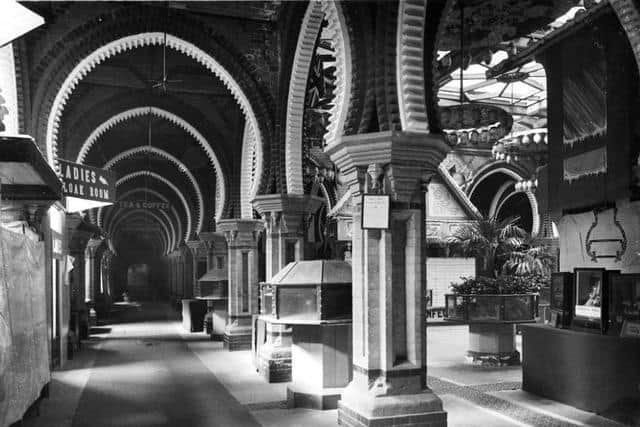
Remarkably, this site had once been an ambitiously exuberant endeavour in High Victorian extravagance, in the form of an extraordinary underground educational and entertainment complex renowned for the richness of its architectural design and ornamentation.
With the expansion of the railways to the coast and emblematic of the confidence and entrepreneurship of seaside development in the Victorian period, it consisted of a lavish and palatial subterranean temple-like interior that had housed the largest aquarium in the world at the time.
No ordinary instance of late-Victorian architecture, this most idiosyncratic of venues would, however, experience a succession of differing incarnations in its 88-year-old chequered past.
Opening in 1877 as The Scarborough Marine Aquarium, it had followed a similar, but smaller such venture established five years earlier in Brighton in 1872.
Both were designed by the eminent architect and railway engineer Eugenius Birch (1818-1884).
Birch, influenced by his visits to India and in parallel to the increasing cultural interest in the sub-continent, envisaged a particular design aesthetic that culminated in a grandiose architectural anomaly that was more akin to an exotic film set.
Covering an area of three acres, it comprised a cavernous network of arched labyrinthine galleries and saloons executed in elaborate coloured brickwork and encaustic tiles.
Emphasising an upmarket educational and scientific approach, it housed numerous tanks of water-borne wildlife including alligators, seals and a wide variety of fish, in addition to a fernery, an aviary and exclusive dining and reading rooms.
Succumbing to the dictates of the marketplace of the time, The Aquarium became unviable financially and was subsequently bought in 1886 by William Morgan, the manager of Blackpool’s Winter Gardens.
Reimagined as The People's Palace and Aquarium, in the endeavour to widen its commercial appeal, it metamorphosed into a more diverse entertainment complex, that included a Japanese theatre, monkey house, aviary and zoo with a range of shops, stalls and a tea house.
Whilst remaining closed for the duration of WW1, subsequently from 1923 onwards in the ownership of the Corporation its reinvention continued as Gala Land in 1925.
In this third variation, it evolved into a more downmarket populist seaside funfair attraction.
Concerts, a circus, a maze, children's rides and fairground-type stalls, shops and a cafe became its principal elements.
Tempered once again decades later by financial constraints, Gala Land would finally close its doors in 1966.
Scarborough Library archivists Austen Sleightholme and Vanessa Milner, chair of Scarborough Archaeological and Historical Society who are to co-present an illustrated talk at The Salvation Army Hall jointly commented: “Many locals have fond memories of Gala Land and others are curious about its stories.
“We aim to examine the reasons and entrepreneurs behind the scheme and its eventual demise.”
Despondently, the future of Eugenius Birch’s creation as an existing venue would never be permanently resolved.
Despite adding spectacularly (and almost uniquely) to Scarborough’s distinctiveness amongst its UK seaside rivals, it was viewed as a redundant, antiquated anachronism and condemned as obsolete.
With that resulting perceived obsolescence in Scarborough’s Mahomedian-Indian architectural gem, the entire site was bulldozed into oblivion in 1968 and subsequently diminished to the lowest common denominator of structures, in the form of the current roundabout and underground car park.
Of the two large aquaria Birch built, in comparison, Brighton, similarly, an archetypal Victorian seaside resort, in retaining its aquarium, had the enlightened foresight to conserve its inherited legacy and today it is Sea Life Brighton.
It is the oldest operational aquarium in the world and a protected Grade II listed building, (rated as of national importance and special interest).
In retrospect, Scarborough’s loss could be argued, as a searing indictment on the reprehensible lack of vision especially in regard to the amenity's particular architectural rarity nationally and a primary example of the town’s past abandonment of its grand Victorian heritage.
Over the decades, the seemingly habitual myopic disconnect between inherited historic buildings and amenities and the imagination to embrace refurbishment and a new use, has much to the great consternation of both residents and visitors alike, continuously blighted the townscape of Scarborough.
The litany of such controversies continued with the most recent example being the demolition of architect Frank Tugwell’s 1920’s Futurist Theatre in 2018.
Viewed historically, and in the context of the 400th anniversary this year of the town as Britain’s first seaside destination, the Aquarium complex formed a significant milestone in the story of Scarborough’s development as a leading coastal resort in the late 19th century.
From opulent Arabesque architectural Victoriana to the ignobility of the soulless sterility and grim banal anonymity of the underground car park.
The brutally stark contrast with the site’s architectural predecessor could not be more exaggerated.
Vanessa Milner & Austen Sleightholme present a talk on Gala Land for the Scarborough Archaeological & Historical Society at The Salvation Army Hall in Alma Parade on Monday, January 12 with doors open from 7pm.
‘Echoes From The Past: Scarborough’s Lost Aquarium’ is at Scarborough Art Gallery until Saturday, February 7.
See sahs.org.uk and scarboroughmuseumsandgalleries.org.uk for further information.