
The nomadic Scarborough-born photojournalist with a mission for humanitarian storytelling
With a career spanning over 26 years, Peter Caton has spent the last 19 of those living almost entirely on the road, visually documenting life in some of the world’s poorest countries.
In advance of the launch of Mr Caton’s book ‘Unyielding Floods’, Patrick Argent meets the Scarborough-born award-winning international photographer whose career aim has been to highlight the environmental and human cost of natural disasters and climate change.
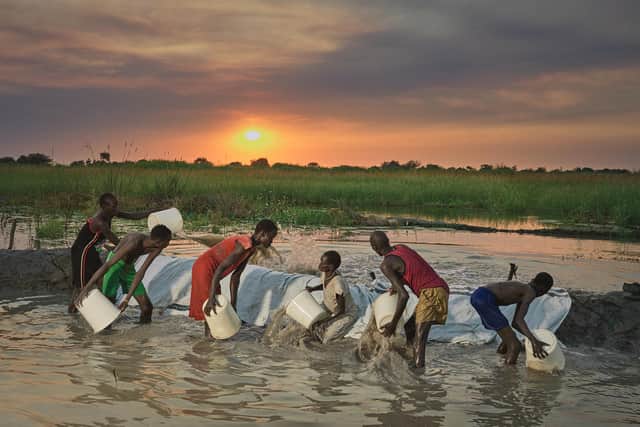

The forbidding threats of roaming armed militias, contracting malaria or encountering Nile crocodiles in flood waters are not occupational hazards that accompany most people’s average working day.
For the highly committed humanitarian photographer Peter Caton however, these can be ever-present daily realities that he bears with admirable stoicism in his unceasing pursuit of his highly specialised form of reportage.

Travelling across Asia, South America and Africa, he has concentrated on portraying critical issues in the developing world, with a distinct focus on climate-related crises.
This fully immersive Indiana Jones-like approach to his ethically-inspired photography has seen him work in over 30 countries for global charity organisations such as Oxfam, Save the Children, the Red Cross, Greenpeace, and Action Against Hunger.
His work has appeared in The Guardian, National Geographic magazine, National Public Radio and The Sunday Times Magazine, and exhibited internationally from London’s OXO Gallery to MOMA Brasília.
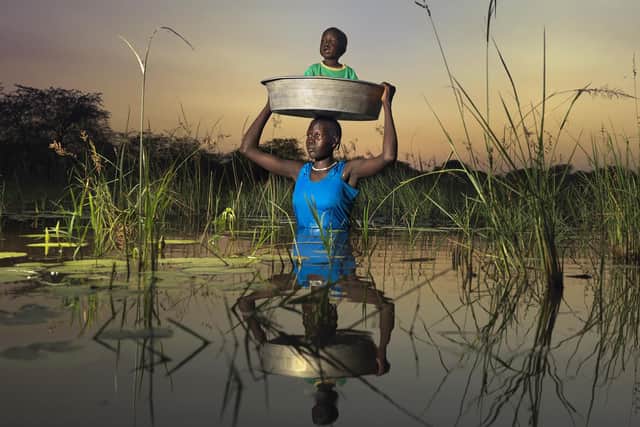
Caton’s poignant and often dramatically haunting portraits convey documentary photography executed unusually with a fashion photographer’s eye, creating a highly distinctive visual signature.
As opposed to more conventional photojournalism, he has developed a striking, almost cinematic approach to his particular subject matter where in-situ outdoor locations become his temporary de facto ‘studio’.
"The equipment I use dictates my style, because I use medium format, there is a slower approach. It is much more concise in respect of how you photograph your subject.
“I mix that in with studio lighting – a studio camera with studio lighting.
“I bring these into the most remotest of places to create a stylised fashion quality to the images.
“It is deliberate and it is my unique style.
“I do portraiture with deadpan landscape to contextualise the photo essay”, he explained, “but technically I am a photojournalist as I am telling a story”.
“Everything is about access”. Mr. Caton continued: “The clients (the charities) give me the access when you are working in these places, you are working on delicate, sensitive issues, it can take months, years even to gain access, especially a working as a foreigner.”
Caton was brought up in Scarborough where, his parents Pam and John ran a children’s home.
Initially encouraged by his art teacher Ian Parkinson at Scarborough College who introduced him to photography, he subsequently embarked on six years of specialised studies.
A GCSE year at Scarborough Sixth Form College, a National Diploma at Harrogate College of Art & Design for two years and whilst on a three year degree course at Cleveland College of Art & Design he was to be immediately inspired by the work of the Brazilian photographer Sebastião Salgado.
“I had started my degree in photography and still undecided as to which avenue I wanted to go down, I watched a documentary on Salgado and was blown away – the light switched on completely - at that moment I knew exactly what I needed to do,” he stated.
Caton’s impassioned interest in the medium, the defining inspiration of Salgado’s images combined with a fervent desire to see the world, would prove to be the catalyst for his future career and accompanying professional nomadic lifestyle.
After graduation, purchasing a medium format camera through a Prince’s Trust grant, he initially travelled to India in 1999, fortuitously being offered a commission by Greenpeace International in Bhopal, covering the ongoing affects on the 15th anniversary of the industrial gas disaster.
This and a further assignment highlighting the work in combatting leprosy, would set the template for the direction of his later career.
After a period of working as a photographer for magazines in London, he decided aged 30 to settle in India and be permanently on location abroad.
Significantly, this move coincided with the emergence of digital photography, which meant his previous reliance on the availability of film processing studios was removed, immediately liberating his professional modus operandi.
Earlier this year, finding much of photography work on hold due to recent cuts to international aid in both the US and the UK, in April he initiated a Kickstarter campaign to fund the publication of a book of his South Sudan pictures.
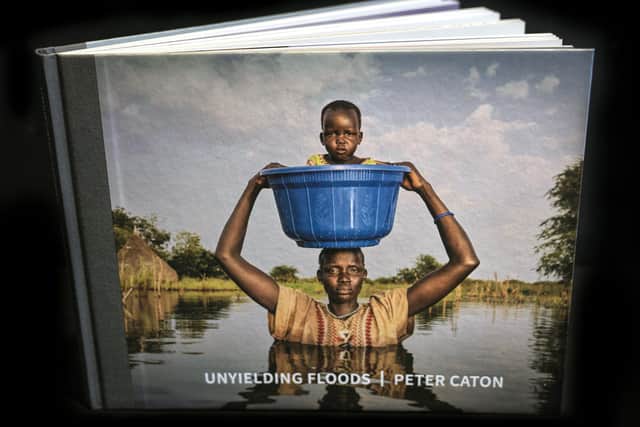
The result of this and the culmination of the past four years fieldwork in that country, is presented in his 126-page hardback book ‘Unyielding Floods’.
This body of photo essays conveys everyday life for communities forced to adapt to a waterlogged existence where families sleep on rafts, harvest water lilies for survival, who are compelled to navigate chest-deep waters to protect their homes and livelihoods.
“This isn’t just a story of disaster,” says Caton. “It’s a story of adaptation, of survival, and of people who continue to resist erasure by simply existing.”
The South Sudanese project has since earned Mr Caton eight international awards, and has been exhibited and published globally.
‘Unyielding Floods’ is published by Dewi Lewis Publishing.
Accompanying the launch of his book, Peter Caton presents a talk at Scarborough Library on Saturday, August 30 at 1pm.
Admission is free.
Further information can be found at https://www.petercaton.co.uk/product/into-the-floods-photobook/.