
Government says it will ‘ban fracking for good’ as North Yorkshire Council set to decide on Burniston gas rig plan ‘soon’
The Department for Energy has said it intends to “ban fracking for good” as North Yorkshire Council has requested details on the timeline and scope of proposed legislation.
The council has said it needs clarity on a proposed permanent ban on fracking and whether the definition of the current moratorium will be expanded, as an application by Europa Oil and Gas for a 38m gas rig near Scarborough remains undecided.
The company’s proposal in Burniston would use a “proppant squeeze” method to extract gas, which is not included in the current ban, but has received objections from more than 1,500 locals.
A spokesperson for the Department for Energy Security and Net Zero (DESNZ) said: “We intend to ban fracking for good and make Britain a clean energy superpower to protect current and future generations.”
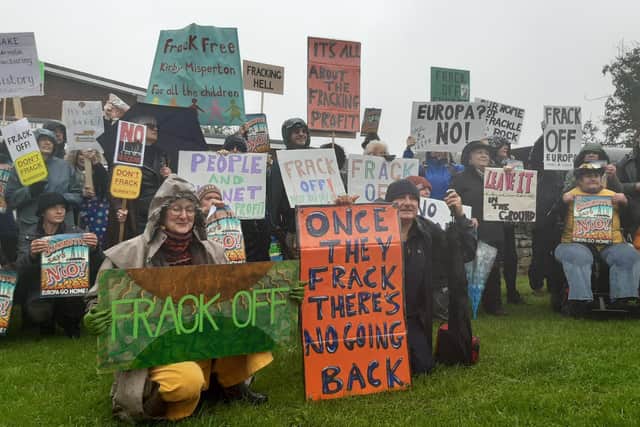

Speaking to the Local Democracy Reporting Service (LDRS), they added: “Proppant squeezes are used in conventional oil and gas operations.
“They do not have the same associated risks as hydraulic fracturing for shale gas extraction, so are not in scope of the effective moratorium.”
Europa said that its plan for “low volume hydraulic fracture in no way infringes on the law” and has maintained that “it is a misconception that there is a loophole” in the fracking moratorium.
North Yorkshire Council noted that third parties, including Friends of the Earth which obtained legal advice on the matter, “contend that the moratorium should include operations of this nature”.
Alison Hume, the MP for Scarborough and Whitby, said she had been “campaigning hard to try and ensure the proposal to frack in Burniston does not receive the go-ahead” and was “lobbying government colleagues hard to include small-scale fracking in the forthcoming ban”.
She told the LDRS: “This reflects my commitment to closing the loophole which, as far as I’m concerned, Europa Oil and Gas, who are behind the Burniston application, are trying to exploit.
“Fracking is subject to a government moratorium. Although legislation does not define proppant-squeezing as high-volume fracking, I’m encouraged the government is committed to banning fracking for good and confident that any future decision on national planning policy will take into account all volumes of hydraulic fracturing.”
Europa said that proppant squeeze operations “are used regularly and safely across industry” and that it would “continue to engage with all the relevant authorities in the appropriate way to explain this and address any concerns”.
Coun Richard Parsons, chairman of Burniston Parish Council, said he welcomed the government’s intention to ban fracking.
“I would remind them that fracking and proppant squeeze are hydraulic fracturing,” he said.
“The process of forcing propellants into rock using high pressure is all the same, whichever label is used.”
Speaking to the LDRS, he added: “The Department for Energy Security and Net Zero needs to be certain that the current moratorium becomes a ban on all hydraulic fracturing that presents a risk to our communities.
“There needs to be certainty that there is no risk and that certainty needs to be evidenced with factual data.”