
Major medieval structure, prehistoric artefacts, and WWII Military Evidence unearthed at Huttons Ambo
Ethos Heritage CIC has concluded its 2026 summer excavation season at Huttons Ambo, revealing one of the most substantial medieval structures yet identified in the village, alongside rare prehistoric artefacts and significant WWII military material.
Now in its fourth year, the projectrun in partnership with the Huttons Ambo Local History Group welcomed over 70 participants from the UK, Europe, the Americas, and Australia as well as participants from the local area.
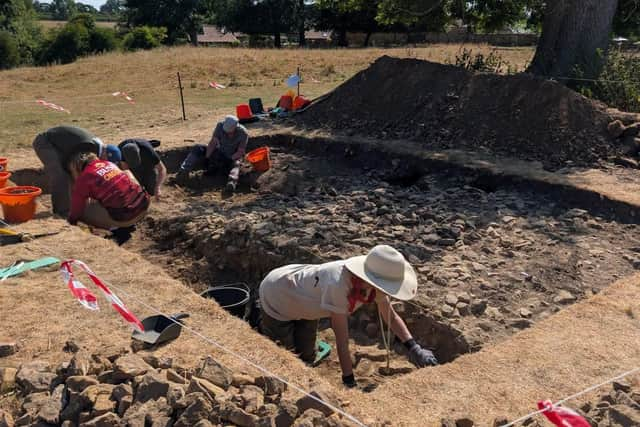

This season’s headline discovery was a large stone-built structure measuring approximately four metres by three metres, uncovered in one of the main trenches.
The building’s walls, floor surfaces, and associated features indicate a high‑status medieval structure, possibly linked to organised agricultural or administrative activity.
Excavation of the interior and surrounding deposits produced over five kilograms of 12th–13th‑century pottery, along with butchered animal bone, suggesting sustained occupation or use.
The density and quality of the finds point to a significant building at the heart of medieval Huttons Ambo.
Finds from the second trench excavated reinforce the importance of the medieval landscape.
Excavators uncovered a series of 12th‑century pits, containing locally produced pottery consistent with the dating of the main stone structure.
Although the exact function of these pits remains uncertain—possibilities include storage, waste disposal, or small‑scale industrial activity—ongoing analysis will help clarify their role within the wider medieval settlement.
Their contemporaneity with the stone building strengthens the emerging picture of a well‑organised and active community during this period.
A major new dimension to the site’s history emerged through the recovery of sizable quantities of WWII artefacts, confirming Huttons Ambo’s role as a base for Allied units training for the invasion of France.
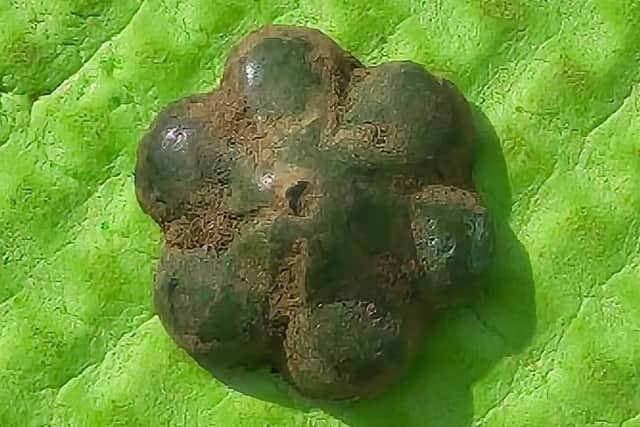
The dates of the equipment—primarily 1943–44 indicate the presence of Free French, Polish, American, and British troops. Finds included belt buckles, cap badges and uniform buttons.
These discoveries provide tangible evidence of the multinational forces who passed through the village during preparations for D‑Day, adding a modern military chapter to a landscape already rich in earlier history.
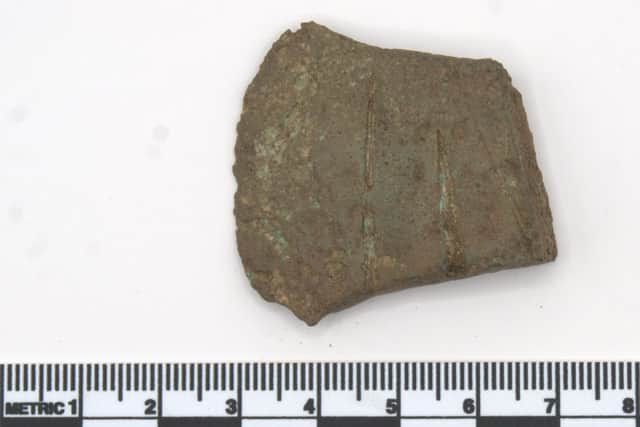
Among the most remarkable finds was a Voltaic Bronze Age axe, dating broadly between 1500–1000 BC.
Unlike axes intended for practical use, this example shows characteristics associated with ritual deposition and deliberate damage. Its placement, condition, and context strongly suggest it was deliberately offered to the gods, part of a wider Bronze Age tradition of placing valuable objects into the landscape as acts of devotion, thanksgiving, or spiritual communication.
The discovery of this axe indicates that Huttons Ambo held possible ritual importance long before the medieval village emerged.
The excavation also produced a Viking‑period weight, reinforcing the site’s long-term role in trade and craft production. Combined with Roman pottery, medieval structures, WWII military material, and 20th‑century features, the 2026 season highlights Huttons Ambo as a landscape shaped by thousands of years of human activity.
Rianca Vogles, the Site Director said: “As site director for the excavations, I cannot emphasise enough how important it is for villages like Huttons Ambo to have the chance to explore their own archaeology and heritage.
"This work doesn’t just uncover the past it strengthens community identity, pride, and understanding.
Post‑excavation analysis is now underway, with detailed study of the medieval pits, the pottery, bone, the stone structure, and the WWII assemblage a priority.
Results will be shared through public talks, digital updates, and future community events.