
RNLI: The fifth lifeboat and the story of the Staithes' Grace Darling
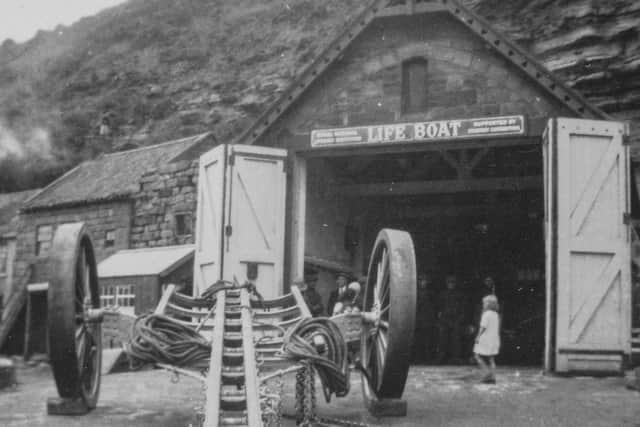
The new lifeboat for Staithes arrived on 12 April 1907, a 35ft. x 8ft.3in. self-righter provided from the legacy of Mr J. Gowland. Whilst at Staithes the lifeboat launched 17 times and saved 32 lives.
In the early 1900’s industry in the area was booming, with ironworks and ironstone mines locally, the Durham coalfield and burgeoning chemical industries on Teesside.

All of which generated greater coastal traffic.
Heavily laden with coal and on voyage from Wallsend to Rotterdam, the Cardiff steamer Enterprise had grounded on Cowbar Steel on June 15 1907.
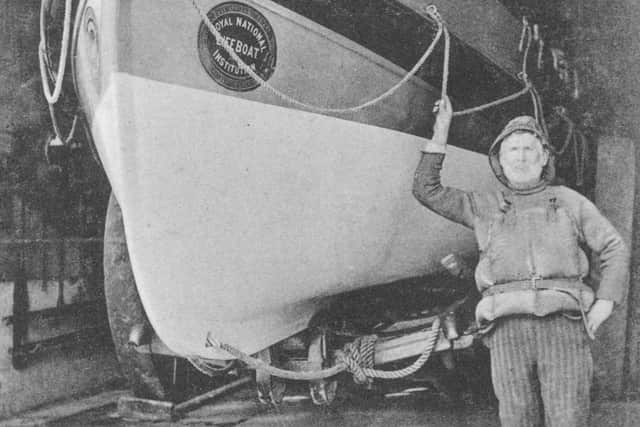
Several cobles launched to assist the stranded vessel, but the weather worsening they embarked the captain’s wife and daughter, and as such the James Gowland had its first service launch at 1.30am on June 16.
Fifteen crew were initially rescued with the captain refusing to leave his ship.
Eventually after the lifeboat standing by the stranded ship the captain was taken aboard when it was deduced there was very little chance of saving the ship.
Long services were familiar to the volunteer crew in Staithes, on December 3 1908 the James Gowland, having returned from escorting cobles in dense fog and heavy seas the previous day, was again launched at 11.30am to the screw steamer Marion of Dundee.
The ship had run aground through the morning but had refloated when the lifeboatmen located her north of Staithes.
Alas the vessel was crippled, missing her propeller. With the assistance of the lifeboatmen, the steamer was brought to deeper water and, as the Tees-side Weekly Herald of Saturday December 12 1908 reports, the James Gowland, Coxswain Horne and the lifeboat crew stood by all night and signalled to a ship familiar to the Staithes lifeboat, the screw steamer Ethel, of Stockton, who took both the wounded steamer Marion and the lifeboat on tow to Middlesbrough at 11.30am on Friday December 4, with the lifeboat returning to Staithes later that day when conditions improved.
In the early hours of February 11 1909, the schooner Elise collided with a steamer when on voyage from South Shields.
The steamer stood by until daybreak, as a north easterly gale blew.
The schooner was driven on the rocks on Penny Steel and broke to pieces almost immediately.
Before this happened, the lifeboat was launched but it was impossible to reach the ship to effect a vessel to vessel rescue.
Two of the schooners crew were killed by a falling mast when the vessel began to break up, and another drowned.
The James Gowland stood by in the best possible position to pick up the crew who had jumped overboard.
Four men reached the lifeboat in a very exhausted state, another man was seen near the rocks, the boat unable to reach him, Matthew Verrill jumped into the sea and by swimming brought him within reach of men who had gone into the surf from the shore to save him.
Others from the Elise were rescued by the volunteers of the rocket brigade, including the captain’s son being rescued by Miss Mary (Mollie) Verrill, and carried to the Cod and Lobster.
Both Matthew Verrill, volunteer RNLI crew member, and Dick Porritt, of the Lifesaving Apparatus Team, had a medal awarded by the Board of Trade for their efforts in this rescue.
September 11, 1909, saw a most unusual rescue, when the Staithes Lifeboat James Gowland was called to the aid of a vessel named Staithes.
The steamer was owned by the Grinkle Iron Co. and had just departed from Port Mulgrave.
In dense fog the screw steamer had run aground on Cowbar Steel.
Mollie Verrill, readily volunteered to take her fathers place in the rocket brigade as he was on the lifeboat – rushing into the sea up to her waist and pulled at the rocket line for all she was worth.
Standing by with waves crashing around her until the lifeboat assisted the stricken steamer, which was refloated on the next high tide.
The captain of the S.S. Staithes later presented Mollie with a gold locket and chain, inscribed ‘Mary Verrill, for Bravery’.
Mollie shortly after appeared at and won a beauty contest which took place in Middlesbrough.
Having seen her image in local media a Thornaby man Mr Reginald Raistrick was so taken with Mollie that he started a romance with her and they were married in 1910.
In local press Mollie became known as Staithes’ Grace Darling.
In 1910, Charles Horne retired as Coxswain of the lifeboat, having been Coxswain for 24 years.
The new Coxswain was George Webster.
It would be almost three years until the next service call for the James Gowland, on June 5, 1912, the lifeboat again launched to stand by the village’s cobles returning in heavy seas.
The coble Love Devine was in great difficulty amid a north north easterly with heavy seas on March 7 1913.
Having lost her rudder the lifeboatmen launched and assisted the coble and crew safely to the beach.
George Webster retired as Coxswain in 1915, his position being taken by Matthew Verrill.
On April 3 1917, the James Gowland launched to the aid of the Lucerne a trawler from Grimsby which was discovered to have been holed, her 11 crew were rescued and landed at Staithes.
The trawler filling with water on the high tide was, as reported in the Whitby Gazette of Friday April 13 1917, re-floated.
It was towed by salvors to Whitby, repaired and its hold of fish dispatched to Grimsby by rail.
The screw steamer Eros got into difficulty having come aground in thick fog on December 20, 1917.
Launching at 8.15pm the volunteer lifeboat crew attempted to embark the crew of the Eros, who refused to abandon ship.
As the wind and sea increased, they soon changed their mind and 19 crew were taken off and landed safely in Staithes.
What proved to be the last service launch for the Staithes lifeboat before the closure of the station in April 1922 was on the evening of May 29 1920.
The screw steamer Teeswood of Middlesbrough had come aground a mile or so north of Staithes. Undamaged the steamer was re-floated on the next flood tide.
The lifeboat returned to the station and did not see another service launch before closure.
The James Gowland looks to have been removed from Staithes in the closing days of March 1922, with a report in the Yorkshire Post of April 1 1922 telling how the boat was dragged through the village streets to the railway station by horses on its keel.
Local fishermen judged the closure as ‘most deplorable’, but a motor lifeboat had been recently placed on service in Whitby, the station in Saltburn was still operational with a rowing lifeboat and indeed likewise at Runswick with the lifeboat Hester Rothschild being in service.
The James Gowland became a relief boat until 1925 then was sent to Arbroath until 1931.