
Up to 25cm of snow predicted as Amber weather warning issued for Scarborough, Whitby and Bridlington
Frequent wintry showers, leading to significant snow accumulations, are likely to cause disruption across the Yorkshire coast as the Met Office issues an amber weather warning.
An amber weather warning for snow has been issued by the Met Office- the amber rating means that this warning has a medium likelihood and a medium impact.
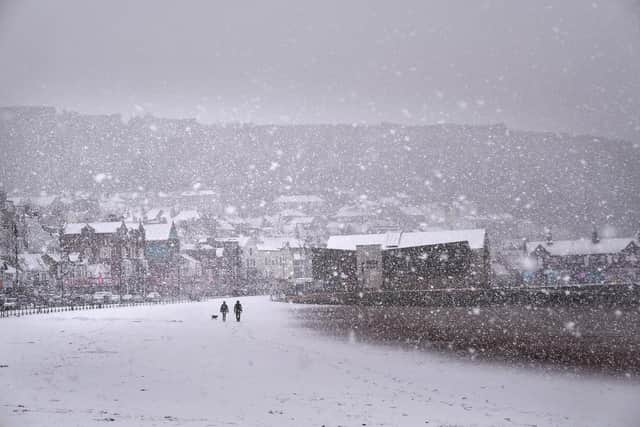

The amber warning will be on place from 5am on Thursday (November 20) until 9pm the same day.
The yellow weather warning for snow and ice has also expanded its timings, with it now in place from 12am Wednesday (November 19) until 11:59pm on Thursday (November 20).
Both of these Met Office warnings cover the Yorkshire coast, including Scarborough, Whitby and Bridlington.
What should I expect?
Travel delays on roads are likely, stranding some vehicles and passengers.
Power cuts are likely and other services, such as mobile phone coverage, may be affected.
There is a good chance that some rural communities could become cut off.
Some delays and cancellations to train and buses services are likely.
The Met Office have said: “Frequent wintry showers will feed inland from the North Sea, giving significant snow accumulations over the North York Moors and parts of the Yorkshire Wolds.
"By the end of Thursday, as much as 15-25 cm may have accumulated on hills above 100 m elevation, which is likely to cause substantial disruption.
"Gusty winds, giving occasional blizzard conditions, and perhaps a few lightning strikes, may accompany some of the showers, posing as additional hazards.”
What Should I Do? It is safer not to drive in these conditions, but if you need to make an essential journey, consider alternative forms of transport, to keep you and others safe. If you must drive, do this more safely by: using dipped headlights; accelerating gently, using low revs and changing to higher gears as quickly as possible; starting in second gear to help with wheel slip; maintaining a safe and steady speed, keeping distance from other vehicles; using a low gear to go downhill, avoiding braking unless necessary; steering into skids, not taking your hands of the wheel, and avoiding slamming on brakes. Help to protect vulnerable people that you know including older people, those with underlying conditions and those who live alone; they may need support with food and medical supplies. If you are worried about your health or that of somebody you know, ring NHS 111 (or consult NI:DIRECT if in Northern Ireland). Stay up to date with the weather forecast for your area and follow advice from emergency services and local authorities.
Visit https://weather.metoffice.gov.uk/warnings-and-advice/seasonal-advice/stay-safe-in-snow for further advice.