
1876: Recounting the fiery demise of Sir Joseph Paxton’s Scarborough Spa
The tumultuous events of the evening of Friday September 8, 1876 would prove to have a far-reaching impact on the development of Scarborough, which still profoundly influences the resort today.
On the 150th anniversary of the Spa fire, Patrick Argent relates the story of the conflagration that engulfed what had been the most popular music hall venue outside of London.

With the town’s rapid expansion coinciding with the advent of the railways reaching the coast in the mid-1840’s, a number of nationally known architects were commissioned to design several of Scarborough’s most prominent and prestigious buildings.
They would include the Gothic Revivalist and ecclesiastical specialist George Frederick Bodley (St. Martin’s Church, 1863), Leeds Town Hall architect Cuthbert Brodrick (The Grand Hotel, 1867) and the seemingly ubiquitous Eugenius Birch (The Aquarium, 1877).
Amongst this elite cohort of Victorian architectural luminaries, one particular preeminent figure, was that of Sir Joseph Paxton (1803-1865), designer of world-renowned Crystal Palace in Hyde Park in London.
Built to stage the hugely ambitious international Great Exhibition of 1851, Paxton’s revolutionary design for a vast cathedral-like edifice of glass and iron would be a pioneering innovation in large-scale prefabricated construction.
The initial embryonic form of the earlier Spa buildings of previous centuries, were superseded in 1839 by the eccentric, castellated sandcastle-like ‘Gothic Saloon’ building by Henry Wyatt (designer of the Town Hall). Seating 500, this was subsequently found to be of inadequate size to meet the demand of ever-growing audience numbers.
Paxton’s design for a new 2,000 capacity Music Hall would be the next stage in the ongoing expansion of the site and more widely, that of the town as a developing coastal resort.
Opened in July 1858, his scheme comprised a large, central Grand Hall with adjoining galleries, an open-air bandstand, three-storey observation tower, an extension to the seawall to form a double promenade, widening the width of the colonnade with shops and establishing a carriage road around the base of the cliff.
The plan also included the arrangement of the adjacent Italian-influenced cliff gardens and balustraded stairways.
Paxton’s Scarborough works would also entail the layout of the southside Westbourne Estate and Weaponness Estate (1862).
Notably, his building is featured in the fictitious society painting ‘The Spa Promenade’ or ‘Scarborough During The Season’ by Thomas Jones Barker (1871), on display in the main corridor of the Town Hall. Prior to the fateful events of the following year, The Spa’s location would also offer the convenience, to ‘avoid 224 steps for 1 penny’, of Britain’s very first funicular cliff railway opened in July of 1875.
The Spa, with Joseph Paxton’s Music Hall at its core, had evolved to become the social epicentre of Victorian Scarborough.
The disastrous fire of September 8 would occur during a fundraising bazaar event for St. Mary's Church. Originating between the ceiling and the roof, molten lead was seen descending from one of the gasoliers that lit the building, which subsequently ignited the woodwork. Within minutes the timber roof would be ablaze, the intensity of the fire further strengthened by both the inflammable contents of the interior and a forceful south-westerly wind.
After three hours, Paxton’s Music Hall was destroyed.
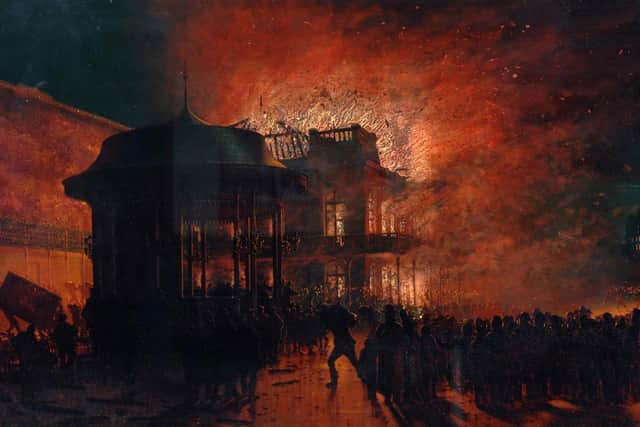
The depiction of the ensuing inferno is captured in ‘The Burning of the Spa, Scarborough’ by the Belgian painter Alphonse Neumans (1853-1893).
With the relatively newly built Grand Hotel in the background, a detail in Neumann’s striking, almost semi-monochromatic painting, notably illustrates the rescue of a valuable painting from the blaze in amongst the crowded throng of watching onlookers.
As John Bedder-Green, of Scarborough Art Gallery, coordinator of a forthcoming display on the event explained: “As part of the event, ‘The Man of Sorrows’ by Sir Noel Patton (now part of The Sandringham Estate) was on display.
It had been loaned for the occasion by Mr. Hare, a gallery owner at 15, St Nicholas Street. The rescue was carried out by a Mr. Jones who was the agent for the piece”.
News of the fire was reported nationwide and even hit the foreign press, appearing in the Sydney Morning Herald in the November of that year.
The exhibition came about due to my love of ‘Sic Transit Gloria Mundi’ (1876) by John Atkinson Grimshaw”, Mr. Bedder-Green said, “This has always been one of my favourite pieces from the Scarborough collection as it reminds me of my earliest memory. In 1975, I was 4 at the time, the Olympia burnt down. I distinctly remember being lifted up to see the glow of the fire that could just be seen from the top floor window of my grandmother’s hotel on New Queen Street.”
Today, a few visible remnants of Paxton’s scheme remain that include the North Terrace with the colonnade beneath, the Versailles-like balustraded staircases, the east elevation of the concert hall and part of the South Terrace.
As with Paxton’s version of the Spa Saloon in 1876, fire would also catastrophically consume The Crystal Palace in 1936.
In the aftermath of the devastation, a new French-influenced, 3,000 seat Grand Hall designed by London architects Verity & Hunt, was constructed. Opened to the public in June 1879, with a formal opening ceremony taking place on 2 August 1880.
“Scarborough at the time was known as ‘The Queen of Spas’ and so the loss of one of its primary entertainments was a blow hence the rapid reconstruction” Mr. Bedder-Green concluded.
Within The Spa’s turbulent history in suffering a destructive major landslip (1737), sea storm damage and latterly the overwhelmingly disastrous fire of 1876, the obliteration of Paxton’s building was the catalyst that would herald the development of the fourth iteration of the entertainment complex as it is known today to artists, residents and visitors alike.
Emblematic of the opulence of the period, it is one of the town's primary Grade II* Victorian listed buildings.
The 1876 Spa Fire display at Scarborough Art Gallery runs from 26th September as part of ‘Dive In! 400 Years of Water, Wellness and Seaside Fun’ exhibition.
Further details are available at scarboroughmuseumsandgalleries.org.uk.