
Scarborough 1066: An enduring enigma of the Norse Sagas
The momentous period of September-October 1066 cloaks an intriguingly unresolved question regarding a less well-known part played by Scarborough in the lead up to the tumultuous conflict depicted in The Bayeux Tapestry.
Patrick Argent relates the story of the town’s reputed role in the wider context of events of that autumn, leading to the Viking battles of Fulford Gate and Stamford Bridge.
These encounters would be the precursors to the impending Norman invasion of England, the outcome of which would fundamentally alter the history of this country.
In the opening sequence of the first episode of Kenneth Clark’s pioneering television series Civilisation (1969), he narrates: “At some time in the 9th Century one could have looked down the Seine and seen the prow of a Viking ship coming up the river.

"Looked at today in the British Museum, it is a powerful work of art: but to a mother of a family trying to settle down in her little hut, it would have seemed less agreeable – as menacing to her civilisation as the periscope of a nuclear submarine”.
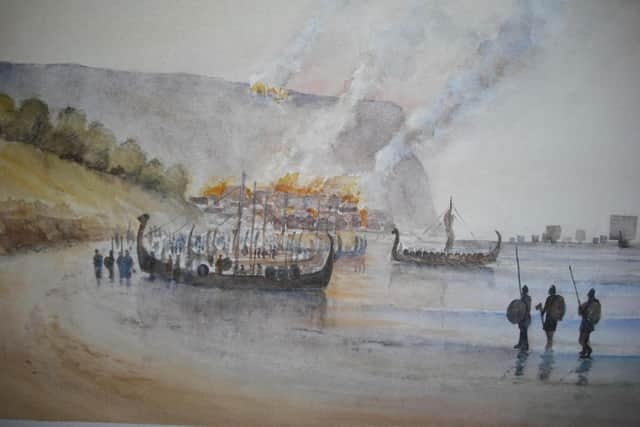
A similar scenario on a much vaster scale may well have occurred in Scarborough’s South Bay amid the early morning light of September 15, 1066, with the intensely foreboding arrival of Harald Sigurdsson’s (Hardrada’s) Viking invasion force of some 300 longships.
The death of Edward the Confessor in January 1066 and the subsequent coronation of his brother-in-law Harold Godwinson, became the fateful catalyst for the ensuing profoundly consequential events of that year.
The formidable Norwegian warrior king claiming a right to the English throne, had traversed the North Sea linking up with his ally the former Earl of Northumbria Tostig Godwinson, the banished and disfavoured Lord of the Manor of Falsgrave, and brother of the newly crowned English monarch.
Cited in numerous history books, the circumstances that allegedly unfolded that day are based on the account in the early 13th Century Scandinavian Heimskringla Saga (History of the Kings of Norway) compiled by the Icelandic poet Snorri Sturluson.
Scarborough in the mid-11th Century, considered by some to have been little more than a small fishing hamlet, was situated beneath the southside of the headland.
With the Norsemen facing resistance, the settlement was subsequently attacked and razed to the ground.
The burning of Scarborough by Hardrada is recounted by Sturluson as: “Harald went up on the rock, which was there, had a huge bonfire built and set fire to it.
“When it was blazing his men took large pitchforks and cast the fire down into the town.
“All the houses caught fire one after the other, and the whole town surrendered.
“The Norsemen killed many there and took all the booty they could lay hands on.
“The English had no choice if they were to survive, but to swear allegiance to King Harald.”
Two decades later the Domesday Book (or Great Survey) of 1086 bears no mention of ‘Scarborough’.
Theories among historians have varied from the town simply being non-existent at the time, the site left barren after Hardrada’s attack, it being subsumed into the entry for Falsgrave as at the time this was the principal community in the vicinity, or being a small fishing community, as opposed to a farmstead, it was discounted for inclusion.
Voyaging down the Yorkshire coast, the immense Viking fleet would pursue their quest to capture York via navigation of the Humber Estuary and the River Ouse.
The Norse invaders, although victorious in the clash with Northumbrian forces at Fulford Gate on Wednesday September 20, were to be roundly defeated by Harold with both Hardrada and Tostig killed at Stamford Bridge on the following Monday 25, this second battle becoming a key factor in events leading to Hastings.
Of the original 300 longships that had arrived in Scarborough nine days before, only 24 of Hardrada’s navy would make the return voyage to Norway.
With a second almost simultaneous invasion, Harold Godwinson was to face further impending peril from another horde of Viking-descended marauders, also intent of relieving him of his newly acquired status as King of England.
Ominously, having embarked from the French coast, William II, Duke of Normandy and his forces would land at Pevensey on the Sussex coast on the September 28.
The Battle of Hastings on Saturday October 14, would ultimately lead to the defeat and dethronement of Harold Godwinson as King of England and the cessation of Anglo-Saxon rule.
‘HAROLD: REX: INTERFECTVS: EST’ - (‘HERE KING HAROLD IS KILLED’) ascribed in Latin announces the demise of Godwinson in the most readily familiar of all the sections of The Bayeux Tapestry.
Revered as one of the most significant of all historical artifacts, it is an extraordinary storyboard-like form of medieval graphic design (text and image to convey a message) with its own marked history spanning the centuries.
Surviving confiscation during The French Revolution (1792), stored during the Franco-Prussian War (1870) and again during WW2, coveted by Heinrich Himmler and held at The Louvre by the Gestapo.
Despite substantial work done in the town, archaeological evidence for the attack has yet to be found.
The enduring question remains as to whether the saga account of Hardrada’s incendiary attack in 1066 can be evidentially confirmed by what would be deemed the ‘Holy Grail’ of Scarborough discoveries.
Former City of York Archaeologist John Oxley MBE commented: “10th and 11th Century Scarborough remains elusive in the archaeological record.
"However, I have no doubt that the evidence is there if we are able to look in the right place”.
Given the Norse sagas, Tostig’s connection to the area, etc. it could be argued the balance of probabilities leads optimistically
towards the account being valid.
Although a relative subsidiary footnote in the story of 1066, if proven indisputably accurate, the attack would further enrich the town’s already remarkable history by substantiating Scarborough’s place in the sequence of events of The Norman Conquest of England.
The Bayeux Tapestry exhibition is at The British Museum until July 11, 2027.
See britishmuseum.org for details.