
Vintage Views with Aled Jones: a lovely hand-tinted harbour vista from 1839
The original print under the spotlight this week is a rare find for collectors of vintage Bridlington artwork and seaside heritage.
Featuring a lovely harbour vista from 1839, the year Charlotte Brontë visited the town, this picture has been hand-tinted in shades of blue and white. With the added value of historical accuracy, it is a useful source of information about the area; G. Furby, its local-based publisher, produced a series of lithograph scenes of Victorian Bridlington when its mineral springs dominated.
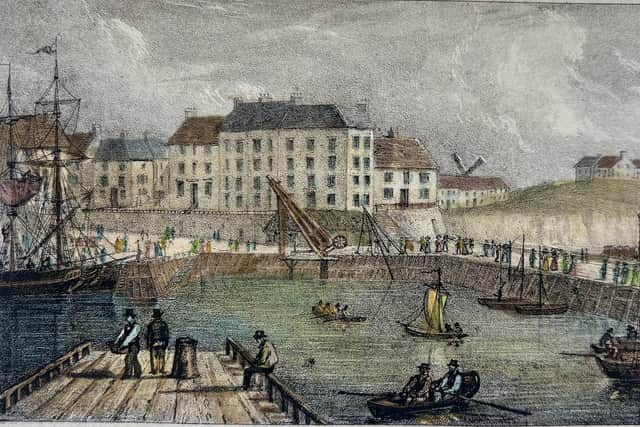

From an era before photography, when folk relied on topographical sketches to see faraway places, my vintage print shows the wooden piers and sailing ships and also the crane at Crane Wharf jetty. The crane was used to haul cobles in and out of the harbour and also to move fish crates.
Notice the fine-dressed promenaders on the North Pier (right) and the rowing boat entering the harbour.
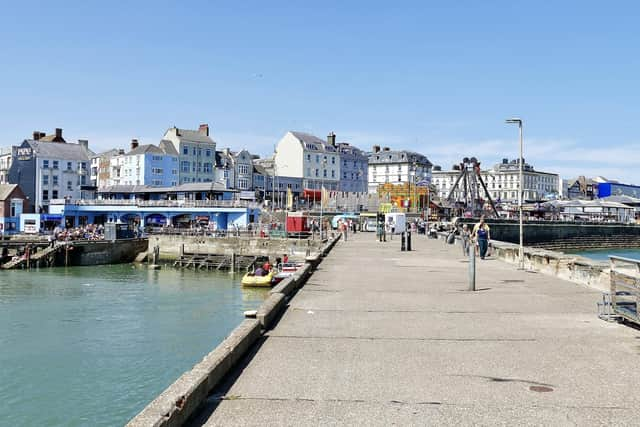
When Charlotte Brontë visited Bridlington in 1839 she joined the promenaders one evening but found the experience quite comical. “The pier,” she later wrote, “was packed like a ballroom until there was hardly room to move, and they had to follow one another round in a circle.”
Beyond the North Pier, which was built of wood infilled with stone, are several bathing machines, a necessity when undressing on the beach was prohibited.
The image was sketched from a limb of the old South Pier which was built in the same position as today’s Chicken Run jetty. In those days the harbour was only a third of today’s size!
The view here bears some resemblance to the present. Two houses featured in the 1839 engraving still exist today. The old coastguard station on Prince Street (Papa’s fish & chips) and the current ice cream parlour (Harbour Delights) on the corner of Garrison Street.
Notice the boulder clay cliffs topped with a mound on the right. The feature may represent glacial till deposits paired with an archaeological feature like a Bronze Age barrow, burial mound, or lookout position.
It will be noticed that the summit of the tumulus is graced with splendid houses.
Today no trace of the mound remains and the site is occupied by Prince’s Parade with the Esplanade above.
Former Cliff Terrace in the centre distance was a fine row of late 18th century town houses bulldozed due to fire damage when the nearby Victoria Rooms burnt down in 1933.