
Vintage Views with Aled Jones: Herman Darewski was a composer who had it all
Immaculately dressed musicians pose for the camera at Bridlington’s new Spa Royal Hall, which opened on Marine Drive in 1926.
The card was posted in September 1926 by a tourist staying at 1a Blackburn Avenue, who wrote, “Just a line to let you know we arrived safely and are enjoying ourselves. The weather is ok. Hope it lasts the week out.”


Of all the fabulous bands that performed in Bridlington, Herman Darewski’s was undoubtedly the best known and liked. Mr Darewski is seated in the centre.
The man’s huge contribution to music, and to the social history of Bridlington, cannot be overstated.
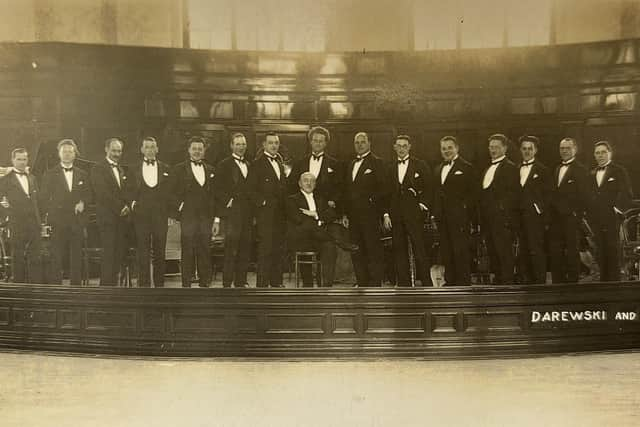
The pre-WW2 era did not idolise him by accident. He was one of the greatest composers and conductors it had, and between 1924 and 1939 he was the reason many people chose Bridlington for a vacation. Indeed, his arrival in Summer 1924 put the Corporation immediately into profit!
As musical director at the Spa, it was Darewski who got Bridlington dancing.
The Darewski Dances, as they were known, created such a youthful furore that the resort soared into the Top 10 list of UK holiday destinations.
But for many older people who lived in the 1920s and 1930s, it is Darewski’s early recordings they loved the most, especially such all-time classic hits as “I Used to Sigh for the Silv’ry Moon” (1909), “Sister Susie’s Sewing Shirts for Soldiers” (1914), and “If You Could Care” (1918).
Original 78rpm shellac records of these vintage songs are highly prized by collectors of British light music and often sell for hundreds of pounds each.
Darewski was a composer who had it all, being one of the first British musicians to compose for the new theatrical form - the Revue. His most successful work was perhaps “The Better Ole”, which played for over 800 performances in its original London production during 1917.
Darewski recorded live inside the uniquely acoustic Royal Hall, capturing multiple sides for the prestigious Parlophone record label. The venue was superior to the “dead” flat rooms of standard London music studios of the inter-war era.
His final commercial recording session took place here in August 1939, just weeks before the outbreak of WW2.