
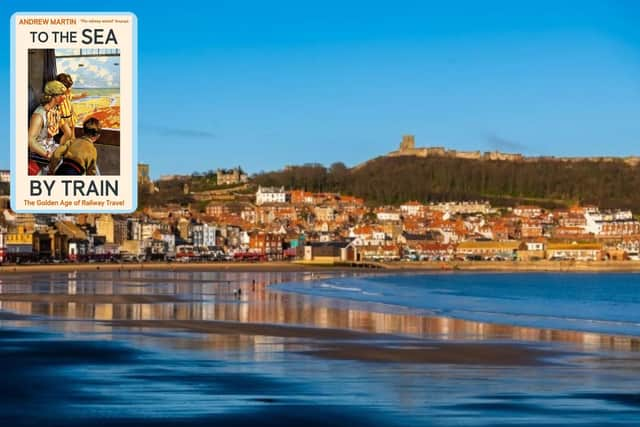
To The Sea By Train: Recalling an evocative past era of seaside travel in Scarborough
One vibrant and highly distinguishable form of graphic design which has retained a timeless universal appeal is that of the vintage railway poster.
Atmospheric, attractively beguiling and occasionally hedonistic, these striking images were used to expressively promote the allure of escaping to the seaside through the medium of illustration.

Commissioned by the various railway companies during the 1920s/30s, designers such as Tom Purvis, Frank Newbould, Tom Eckersley and Frank Mason would create a compelling and effectively persuasive visual aesthetic.
Despite their inherent commercial purpose, original versions of these poster designs would acquire the status of a substantive art form.
Through their rarity also, subsequently becoming highly sought-after works reflected in the auction house prices they command.
Railway historian Andrew Martin’s heavily nostalgic book To The Sea By Train – The Golden Age of Railway Travel, could be viewed as a form of literary accompaniment to this past genre of posters, utilising his trademark historical and anecdotal perspective on various aspects of the British holidaymaker’s bygone experiences.
The Yorkshire-born author will be discussing his book at the national conference of the Seaside Heritage Network organisation in Scarborough on Friday September 18.
To The Sea By Train is an engaging title for a volume that is a part historical/part travelogue hybrid whose key narrative is how trains were the fundamental catalyst for coastal resorts such as Scarborough to develop (the town being an archetypal Victorian example), making the seaside accessible to initially the wealthy and subsequently then to the masses.
Topically, the 12-page section To Scarborough is devoted to the town comprising a summary of post-early 19th Century events up until the closure of the Whitby-Scarborough line in 1965, supplemented by a personalised account of steam excursions on the Scarborough Spa Express.
Reflecting the familiar Victorian imagery of The Spa and promenades along The Esplanade, Martin notes for example: “During the last twenty years or so of La Belle Epoque, Scarborough in season had become a fashionable spectacle which bore some comparison with Rotten Row in London or the Bois de Boulogne in Paris”.
The other main resorts in the area - Whitby, Bridlington and Filey - are all referred to several times throughout the text.
Interspersed with numerous black and white illustrations, the book also prominently features a series of colour plates of mostly less well-known railway posters (including examples promoting Bridlington and the Yorkshire coast.
Throughout, the author also explores various themes of specialised seaside culture, architecture, entertainments, customs and traditions, all of which he emphasises were the direct result of the advent of the railways.
Interestingly included are sections on such topics as class and trains to holiday camps with reference to Butlins at Filey, which remarkably even had its own station.
Authoritative in its detailed railway content and often amusingly written, it forms with objective analysis, a condensed social history of the changing characteristics of domestic coastal tourism from its initial expansion and subsequent heyday, to the gradual decline in recent decades of traditional seaside resorts with the increasing popularity of foreign holidays and the axing of parts of the rail network.
An engaging book, it evokes distant memories of train doors being slammed – a once familiar yet now far-removed sound of pre-electronic era station platforms of the past, found only now on heritage railways.
For rail passengers today, Scarborough's recently refurbished station still retains appreciable testaments to its past.
The practicable quarter-mile long passenger bench (as it was in 1883, Martin points out) is still in use and the impressively large-scaled North Eastern Railway tiled map, is to be found in situ, on the wall on Platform 3.
Andrew Martin presents a talk on To The Sea By Train at the Seaside Heritage Network Conference at The Grand Hotel on Friday September 18, from 1.30pm which is open to the public.
Day tickets are priced at £15. Visit seasideheritage.org for more.
To The Sea By Train –The Golden Age of Railway Travel is published by Profile Books, ISBN 978 1 80522 155 5.
A related talk by Dr Allan Brodie who presents Georgian Scarborough: Spa, Sea & Sex for Big Ideas By The Sea is at St Mary's Church on Saturday September 19, at 3pm.